

By Christine Keehe
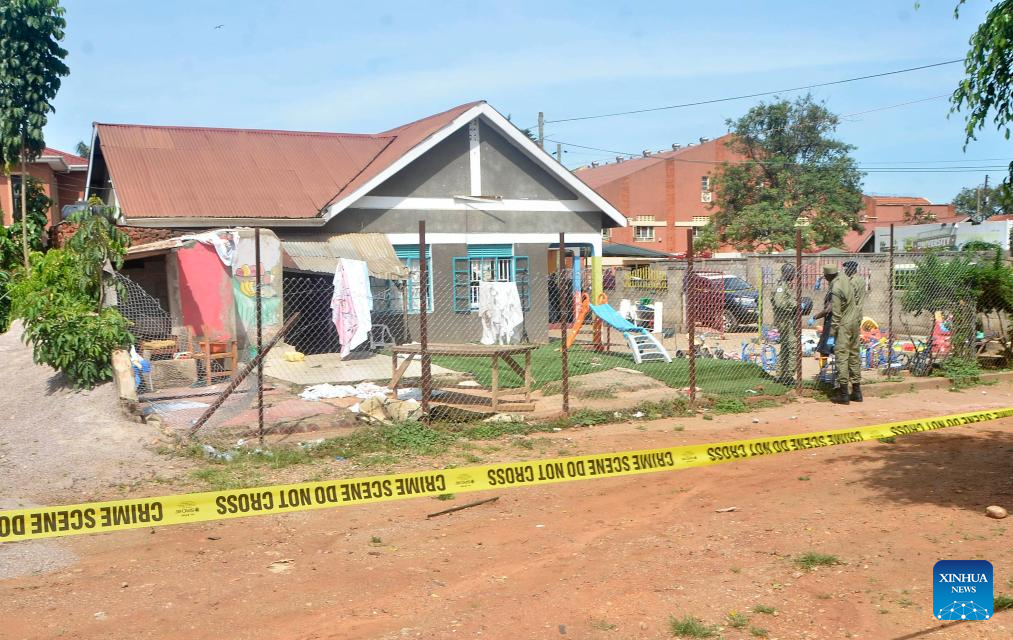
Last week, on an ordinary morning in Ggaba, a place known more for its lakeside calm than horror, parents dropped off their children with the quiet trust that defines parenthood. Backpacks were adjusted, small hands waved goodbye, and promises of “I’ll pick you later” hung in the air, fragile as morning dew, unquestioned as sunrise. Hours later, that trust lay shattered.
In what would become one of the most disturbing acts of violence against children in recent memory, a man walked into a daycare, not as an intruder, but as someone who appeared to belong. He had been there before. He had paid fees. He had spoken politely, like any parent rehearsing normalcy. And then, in a moment that defies comprehension, he turned on the most innocent among us. Four children, barely old enough to speak in full sentences, never made it home.
The question that now grips parents across Kampala and beyond is as simple as it is terrifying: Are our children truly safe anymore?
A new, increasing kind of fear
For many Ugandan parents, fear is not new. It has always existed in whispers, road accidents, illness, and the unpredictability of life. But this is different. This is a fear that enters spaces once considered sacred: schools, daycares, homes. A fear that does not knock, it sits quietly in the corner of a parent’s mind.
In neighbourhoods’ like Kira, Ntinda, and Najjera, parents now admit to a quiet but growing anxiety. Caroline Nakitta, a mother of two in Ntinda, describes how she now calls her child’s school multiple times a day, not because anything has happened, but because something could. “I used to worry about grades,” she says. “Now I worry about whether my child will come back alive.”
At a press briefing, Kampala Metropolitan Police spokesperson Kawala Racheal, speaking on behalf of the Uganda Police Force, acknowledged this rising fear, noting that the incident had “deeply shaken public confidence in spaces once considered safe,” while urging schools and parents to heighten vigilance and tighten access controls. Her statement echoed findings from annual police crime reports, which have consistently shown that children remain vulnerable to violence within familiar environments, homes, schools, and communities they trust. Cases of assault, neglect, and domestic-related harm involving minors continue to be recorded each year, a quiet statistic that rarely captures the full emotional weight behind the numbers.
This shift reflects a broader transformation in parenting: from nurturing growth to managing risk.
Trust, broken in plain sight
What makes the Ggaba tragedy particularly unsettling is not just the violence, it is the method. The attacker did not break in. He blended in, like a shadow that had learned how to smile, and that raises uncomfortable questions. How do you protect children from someone who appears normal? How do schools screen for danger that does not announce itself? And how do parents trust again?
According to guidance often emphasised by institutions like the Uganda Police Force, vigilance is key, but vigilance has limits. No system can fully predict human behaviours, especially when warning signs are subtle or absent. In quiet conversations after the tragedy, one school administrator in Makindye, speaking off record, admitted,
“We prepare for fire. We prepare for sickness. But how do you prepare for a human being who decides, in one moment, to become something else?”
Recent incidents across Uganda deepen this unease. Cases have surfaced of domestic workers assaulting children under their care, children suffering fatal neglect in locked homes, and even tragic instances where minors have been victims of arson or intentional harm within domestic spaces. Each story, though separate, forms part of a disturbing pattern: danger is increasingly intimate, it lives closer than we think.
This is the paradox of modern parenting: you are expected to protect your child from threats you cannot always see.
Parenting in the age of uncertainty
Across Uganda, parenting is quietly evolving. In the past, children moved freely, walking to school in groups, playing in compounds under the watch of neighbours whose eyes were as constant as the sun. Today, many parents are tightening control, pulling their children closer as though the world itself has grown teeth. Fewer unsupervised playtimes, increased reliance on known caregivers, and constant phone check-ins have become the norm.
But experts warn that this hyper-vigilance comes at a cost. Child development specialists from institutions like Makerere University have long noted that overexposure to fear can quietly reshape a child’s psychological landscape, increasing anxiety, limiting independence, and affecting social development. Regional child protection data from organizations such as UNICEF has similarly highlighted that violence against children often occurs in environments meant to protect them, with caregivers, relatives, or trusted individuals frequently implicated.
Often, you cannot blame parents. It stands to reason that parents are caught in a dilemma: protect their children too little, and they risk their safety; protect them too much, and they risk their freedom. What do we do then?
The invisible crisis: who are we raising?
Beyond immediate safety, the tragedy forces a deeper, more uncomfortable reflection: what kind of society produces such acts? While the motive in the Ggaba case remained unclear, mental health professionals in Uganda pointed to a silent crisis, one that grows not in headlines, but in silence. Organisations such as the Ministry of Health (Uganda) have repeatedly raised concern about untreated mental health conditions, substance abuse, and social isolation, particularly among men who are often taught to endure, not express.
In past public health discussions and media engagements, experts have warned that unaddressed psychological distress, when combined with social pressure and economic strain, can manifest in harmful and sometimes violent behaviours. One Kampala-based counsellor, reflecting on the incident, noted, “We are seeing people who are emotionally overwhelmed, socially disconnected, and psychologically unsupported. When distress has no language, it sometimes finds expression in the unthinkable.”
This is not to excuse violence. It is to confront a difficult truth: parenting is not just about raising children, it is also about the emotional worlds we allow, or refuse, to exist in the adults around us.
when the village disappears
Uganda has long prided itself on communal parenting, the idea that “a child belongs to everyone.” But in fast-growing urban centers like Kampala, that village is fading, dissolving quietly into concrete walls and locked gates. Gated homes, busy schedules, and digital lives have replaced shared responsibility.
In Ggaba, the man reportedly visited the daycare more than once. He was seen. He had interacted with them. Yet no alarm was raised. Would things have been different in a tightly knit rural setting, where strangers are noticed the way a new sound is noticed in the night? Or has modern life made us more isolated, and therefore more vulnerable? Paul Mayanja, a resident in Ggaba, speaking after the incident, captured this shift with quiet sadness: “We live next to each other, but we don’t know each other anymore.”
The questions we cannot avoid
The tragedy leaves behind more than grief. It leaves questions, uncomfortable, persistent, and unresolved, like echoes that refuse to fade. Are schools equipped to handle evolving security threats? Should background checks become mandatory for all visitors to child-centered spaces? Are parents asking enough questions about the environments they trust with their children? And perhaps most haunting of all: can we ever eliminate risk completely?
Policy discussions following similar incidents in Uganda have occasionally pointed to stricter childcare regulations, improved school surveillance, and mandatory reporting systems, but implementation often lags behind the urgency, leaving parents suspended between awareness and action. There are no easy answers. Only a growing awareness that parenting today requires more than love, it demands vigilance, adaptability, and sometimes, difficult choices.
Raising children, holding fear
In the days following the Ggaba incident, grief moved through families like a slow, heavy tide. Though the families largely mourned away from cameras, fragments of their pain surfaced, soft, broken, almost too fragile to carry. One relative, speaking to local media, described a home that had fallen unbearably quiet: “The toys are still there… the shoes are still by the door… but the child is not coming back.” Another grieving parent’s words, shared through a community member, lingered like a wound: “You send your child to learn, to grow… not to die.”
Their grief joined a painful archive of similar tragedies Uganda has witnessed over the years, stories of children harmed by those entrusted with their care, of innocence meeting cruelty in spaces meant for safety. Each case adds a layer to a collective sorrow that never fully settles. These are not just statements. They are the sound of a world collapsing in on itself.
And yet, even in fear, parenting continues. Children still laugh. They still run. They still trust, like small flames refusing to be extinguished by a gathering storm. Perhaps that is the greatest responsibility of all, not just to protect them from harm, but to ensure that fear does not define their childhood. Because if fear becomes the foundation of parenting, then something even more profound is lost.
A final reflection
Four children are gone. Their absence is not just a family tragedy; it is a silence that stretches across a nation, heavy and unanswerable. And as Uganda mourned, one truth remained unavoidable: the question is no longer whether danger exists. The question is whether we are prepared for the dangers we see and those we do not. And perhaps, more quietly, more painfully still: what does it mean to raise a child in a world where even innocence is no longer protection?