

By Diana N.Kintu
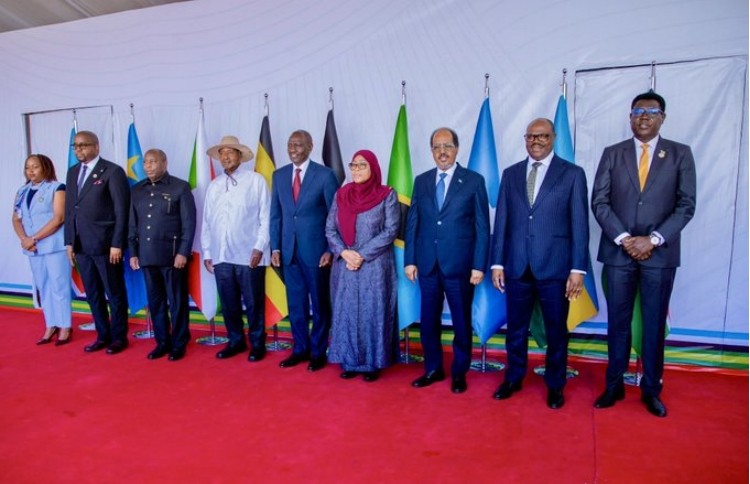
Leaders of the East African Community (EAC) adopted a new financing formula for the regional bloc and launched the 7th EAC Development Strategy at the 25th Ordinary Summit of the EAC Heads of State in Arusha, Tanzania.
The summit, held under the theme “Deepening Integration for Improved Livelihoods of EACCitizens,” brought together leaders from across the region to deliberate on key issues affecting integration, peace, and economic cooperation.
Among those in attendance were William Ruto of Kenya, Évariste Ndayishimiye of Burundi, host president Samia Suluhu Hassan of Tanzania, Yoweri Kaguta Museveni of Uganda, and Hassan Sheikh Mohamud of Somalia. Representatives from Rwanda, South Sudan, and the Democratic Republic of the Congo also participated in the meeting.
During the summit, the Heads of State received a progress report on the Nairobi Process for Eastern DRC peace talks, which aims to restore stability in the conflict-affected eastern region of the Democratic Republic of the Congo.
The leaders commended the efforts of Kenyan President William Ruto to advance the peace initiative and called on all parties to the conflict to cease hostilities and recommit to peaceful dialogue.
The summit also urged the African Union to provide financial and logistical support to strengthen ongoing mediation efforts and sustain progress towards lasting peace in the region.
A major outcome of the meeting was the adoption of a new financing formula for the East African Community. Under the revised arrangement, partner states will contribute 50 per cent through equal partner contributions and 50 per cent through assessed contributions, reflecting each country’s economic capacity.
The new formula is expected to take effect on 1 July 2026. In addition, partner states were directed to clear at least 50 per cent of their outstanding arrears within two years in order to strengthen the financial sustainability of the Community.
The summit also tasked the EAC Council of Ministers with resolving all outstanding non-tariff barriers affecting trade within the region by 30 June 2026. Leaders further directed the Council to fast-track integration roadmaps for the Community’s newer member states, including South Sudan, Somalia, and the Democratic Republic of the Congo.
In his address to the summit, Ugandan President Yoweri Kaguta Museveni, who was elected the new Chairperson of the EAC Authority, called on partner states to renew their commitment to deeper regional integration.
Museveni emphasised the importance of “Uhuru na Umoja” (Freedom and Unity) as guiding principles for the region’s development. He warned against what he described as “Okukonesa”, loosely translated as mismanaging or undermining the African revolution.
According to the Ugandan leader, failure to integrate regional markets and strengthen political cooperation could undermine economic progress and weaken the region’s strategic security.
“If we do not create a big market, how do we intend to encourage and support the wealth creators in our countries?” Museveni asked. “If we are not able to operate effectively on land, air, sea and space, how do we hope to guarantee our strategic security?”
He urged East African states to fully implement the EAC integration roadmap, adopt Swahili as a unifying regional language, and treat the integration process as a mandatory commitment rather than an optional undertaking.
Another key milestone of the summit was the launch of the 7th EAC Development Strategy(2026/27–2030/31), which will guide the Community’s priorities over the next five years. The strategy aims to accelerate economic integration, enhance trade, and improve the livelihoods of citizens across the region.
Leaders also witnessed the rollout of the EAC Customs Bond, assented to several key regional bills, and confirmed the appointment of Stephen Patrick Mbundi of Tanzania as the new Secretary General of the East African Community.
Under the new leadership arrangement, Uganda will chair the Community while Rwanda will serve as the rapporteur.
The Heads of State concluded the summit by expressing appreciation to President Samia Suluhu Hassan and the Government of Tanzania for the warm hospitality extended to delegates during their stay in Arusha.