

By Ssenkayi Ezra Marvin
In the rolling grasslands of Lyantonde District, where the country’s cattle corridor stretches across green hills dotted with Ankole cattle, a quiet but significant transformation is taking place. What was once a struggling dairy operation has now emerged as a model of agro-industrial innovation, driven by locally developed engineering solutions.
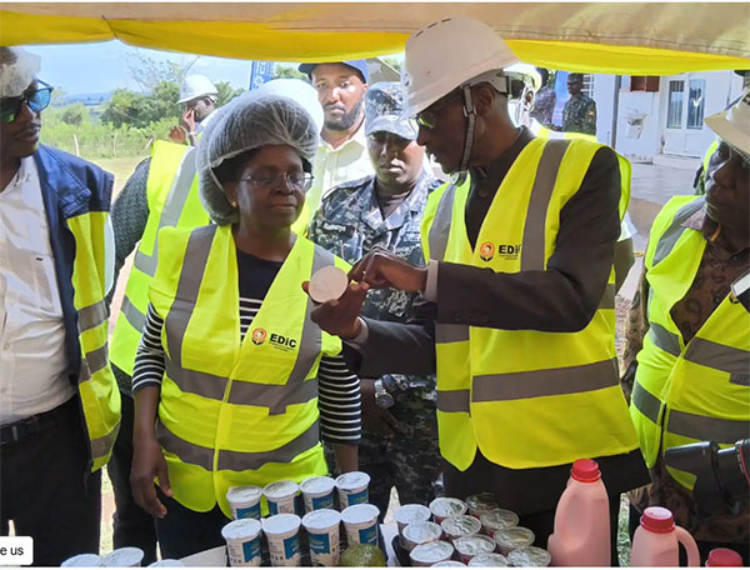
On 22 March 2026, the Engineering Development and Innovation Centre (EDiC), the applied science arm of the Science, Technology and Innovation Secretariat under the Office of the President, officially commissioned the upgraded Katebe Farm Engineering Transformation Project in Kashagama.
The event was presided over by Dr Monica Musenero Masanza, Minister for Science, Technology and Innovation, and attended by farmers, engineers, and local leaders from neighbouring districts including Kiruhura District and Sembabule District.
The commissioning marked a turning point for Katebe Farm, which has undergone a remarkable transition from a small-scale, financially strained yoghurt production facility to a high-capacity, efficient processing plant. The transformation highlights the growing role of home-grown technology in advancing Uganda’s agro-industrialisation agenda.
Katebe Farm was established in 2018 by Kale Kayihura, the former Inspector General of Police, with the aim of creating a reliable market for local dairy farmers. Financing for the project was secured through the Wazalendo Savings and Credit Cooperative Organisation, a financial institution linked to the Uganda People’s Defence Forces.
Despite its ambitions, the project faced significant operational challenges in its early years. Heavy reliance on imported machinery and foreign technical expertise led to high production costs. As a result, the plant could only produce about 500 litres of yoghurt over a 24-hour period, making it difficult to achieve commercial viability.
The intervention by EDiC introduced a set of locally designed engineering solutions tailored to the realities of Uganda’s cattle corridor. Central to the upgrade were the installation of a steam boiler system, a biomass burner, and an improved pasteurisation unit. These innovations significantly reduced energy costs while enhancing production efficiency and product quality.
According to lead engineer Jimmy Kandole, the project was guided by a practical approach aimed at sustainability and affordability. He explained that the biomass burner was specifically selected to address the high cost of conventional fuels, which has long been a challenge for agro-processors.
The results have been substantial. Production capacity has increased sixfold, with the plant now producing up to 3,000 litres of yoghurt in just 12 hours—compared to the previous output of 500 litres in a full day. This improvement not only enhances profitability but also demonstrates the effectiveness of locally developed technological solutions.
Beyond the factory floor, the impact of the transformation is being felt across the wider community. Located at the intersection of multiple districts, Katebe Farm serves as a critical market for more than 15 local milk suppliers. Its operations also support a broader economic ecosystem involving banana and gonja farming, beekeeping, goat rearing, and casual labour, collectively benefiting an estimated 1,000 people.
Local participation is integral to the farm’s success. Community members supply raw materials such as milk and firewood for the biomass system, as well as labour and other inputs, creating a mutually beneficial production chain.
Asiimwe K. Enos, Member of Parliament for Kabula County, described the development as a clear example of the government’s commitment to promoting agro-industrialisation. He noted that improved processing capacity offers farmers a stable market, helping to reduce post-harvest losses and improve incomes in a region where milk has often been sold at low prices or wasted due to lack of buyers.
Speaking at the commissioning, Dr Musenero emphasised that the project represents a broader vision of applying science and innovation to real-world challenges. She noted that the initiative aligns with national efforts to transition from subsistence agriculture to a market-oriented economy driven by value addition.
“This is what it looks like when science leaves the laboratory and goes to the farm,” she said, underscoring the government’s commitment to supporting practical innovations that deliver tangible benefits to communities.