

By Diana N.Kintu
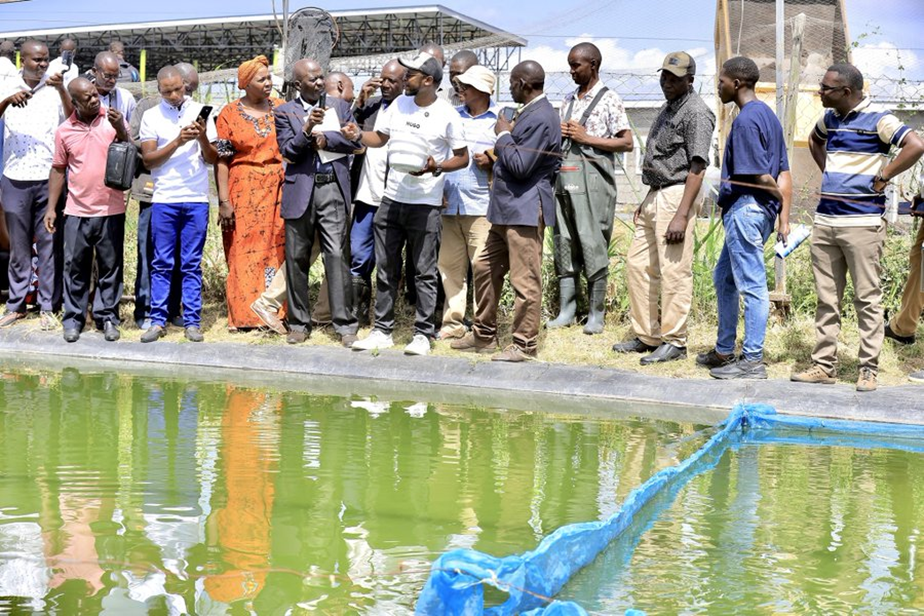
State House Uganda, through the Office of the Special Presidential Assistant for Press and Mobilisation, has sent 60 model farmers from the Busoga sub-region to Kenya for a three-day benchmark study on modern fish and livestock farming.
The study, held at Fish Farm Paradise and Resort, forms part of Yoweri Kaguta Museveni’s broader efforts to diversify household incomes in Busoga beyond sugarcane cultivation.
According to the statement, the initiative reflects the President’s emphasis on alternative sources of income such as fish farming, poultry keeping, cocoa production, and dairy farming.
“Fish farming will help Busoga fight poverty. Busoga is surrounded by water bodies such as Lake Victoria, so we have all the natural resources needed to support the proper utilisation of wetlands,” said Florence Mutyabule, who led the delegation.
She praised the Kenyan model farm for its innovative use of wetlands, including fish hatcheries, ponds for catfish and tilapia, and integration with hospitality services.
“If we establish such ventures in Busoga, we shall be able to create wealth. We also need to establish a holding centre for fish in Busoga to create a market for our farmers,” Mutyabule added.
Stanley Mworia welcomed the Ugandan delegation and showcased modern fish farming methods. He explained that each pond can accommodate 3,000 fish, supported by integrated power systems for aeration and holding tanks that allow farmers to store fish until markets become available.
“We have the capacity to produce 500,000 fish per month,” Mworia said, while urging East African governments to exempt taxes on fish feed ingredients in order to reduce production costs.
Ugandan farmers expressed gratitude for the training. Jacob Kazindura noted that he had learned modern water recycling methods and how to identify profitable fish species.
Mary Immaculate Abwooli called on farmers to form associations to aggregate products and improve bargaining power.
Magala Samuel Ngobi highlighted the need for financial support to establish modern fish ponds, saying the knowledge gained would help improve agricultural enterprises.
The benchmark study is expected to empower Busoga’s model farmers to act as change agents within their districts by applying the lessons learned to boost productivity and promote sustainable livelihoods.