

By Wakibi Iddi
President Yoweri Kaguta Museveni speaks during Uganda’s 64th Independence Day celebrations held at State House, Entebbe, on 9th October 2026.President Yoweri Kaguta Museveni has set a target of growing Uganda’s economy to nearly $74 billion by June 2027, identifying industrialisation, value addition, improved transport infrastructure and household wealth creation as key drivers of the next phase of economic transformation.
Speaking during Uganda’s 64th Independence Day celebrations held at State House, Entebbe, on 9th October 2026, President Museveni said the country had made significant progress since 1986 but needed to expand domestic production and ensure more Ugandans benefit from economic growth.
The celebrations, which had limited physical attendance and were broadcast nationally, were held under the theme, “Embracing Our Sovereignty with Hope and Visionary Leadership.
“President Museveni said Uganda lost 24 years to political instability, conflict and economic decline between independence in 1962 and the National Resistance Movement’s assumption of power in 1986, when the economy stood at approximately $3.9 billion.
He said Government had since pursued successive phases of economic transformation, beginning with recovery, followed by expansion, diversification, value addition and the development of a knowledge-based economy.
Citing progress in traditional sectors, the President said tea production had increased from three million kilogrammes in 1986 to 60 million kilogrammes to date, while coffee production had risen from about three million to nine million bags over the same period.
He argued that Uganda’s next economic gains would depend on processing more of its agricultural produce and raw materials locally, rather than exporting them in raw form.
“When you add value, you get much more money than when you sell raw materials,” he said.
He cited coffee, cotton, milk, fruits and bananas as commodities with greater potential to generate income and employment when processed into higher-value products, alongside electric vehicle manufacturing, pharmaceuticals, science and technology.
President Museveni said transport infrastructure remained a major constraint on competitiveness, citing traffic congestion, heavy cargo movement by road and transportation of petroleum products by tankers.
He said rehabilitation of the existing railway, the planned Standard Gauge Railway, petroleum pipeline infrastructure and improved water transport would help reduce logistics costs and ease pressure on roads. He estimated that inefficiencies in the transport system cost Uganda approximately $1 billion annually.
The President also emphasised that national economic growth must translate into improved household incomes. He said participation in the money economy had risen from 32 per cent to 61 per cent through Operation Wealth Creation and subsequently to 67 per cent under the Parish Development Model.
He called on political, religious and cultural leaders to identify households still outside commercial economic activity and support them to establish sustainable sources of income through agriculture, livestock farming and other productive enterprises.
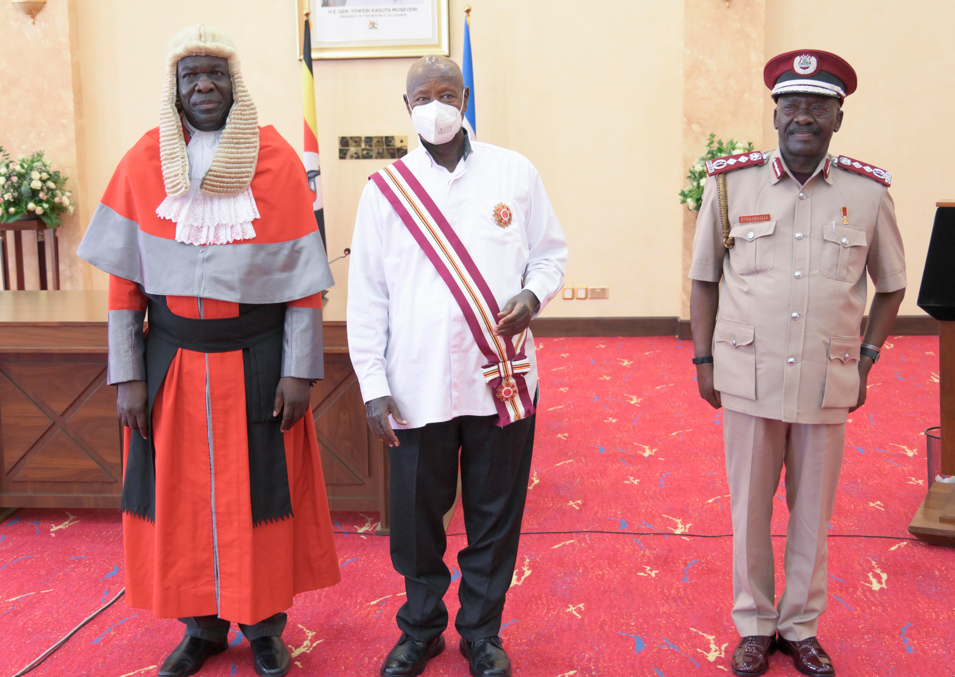
During the celebrations, President Museveni received the Order of the Commander-in-Chief (Uganda Prisons Service Medal) in recognition of his leadership and contribution to peace, security and the development of the Uganda Prisons Service.
The medal was presented by Deputy Chief Justice Justice Moses Kawumi Kazibwe on behalf of the Presidential Awards Committee.
Vice President Jessica Alupo congratulated Ugandans on the anniversary, commending the country’s progress in peace, stability, unity and women’s empowerment.
Minister for the Presidency Milly Babalanda paid tribute to historical figures, including Omukama Kabalega of Bunyoro and Kabaka Mwanga, alongside other patriots who contributed to Uganda’s struggle for independence.
“Uganda’s Independence wasn’t achieved on a silver plate,” she said, emphasising that political freedom must be accompanied by economic and strategic independence.
At least 19 other people, including six women, received awards in recognition of their contributions to the country.
Attorney General Dr Sam Mayanja also launched his book, The Odyssey in the Uganda Land Cobwebs, which examines land matters in Uganda.
As Uganda reflects on 64 years of independence, President Museveni’s message placed greater domestic production, industrial development and household prosperity at the centre of the country’s ambitions.