

By Marvin Ezra Ssenkayi
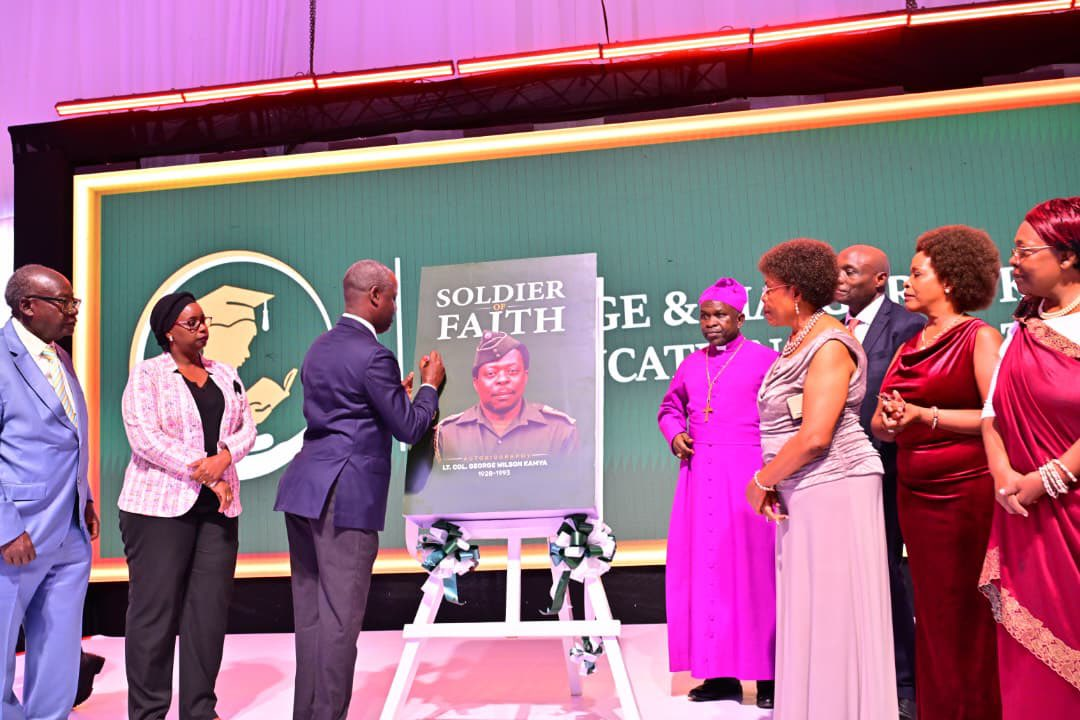
Lt. Col. George Wilson Kamya began writing Soldier of Faith by hand in Nakuru, Kenya, in May 1962. He would not live to see it published. It took sixty-four years, and the patient work of his daughter Edith Nnakajubi Mpanga, to carry his manuscript from his notebook to the stage at Kololo Ceremonial Grounds last Friday, where the book was formally launched by Rt Hon Thomas Tayebwa, the Deputy Speaker of Parliament, who represented President Yoweri Museveni.
That delay, unplanned as it was, has turned out to be a gift. Read today, Soldier of Faith does not merely recount one man’s life. It holds up a mirror to two of our most pressing crises: the quiet epidemic of absent fathers, and the transformation, in too many places, of the soldier from protector into predator. And perhaps that is what makes a handwritten manuscript, preserved across generations, so relevant today: it carries lessons that extend far beyond the lifetime of the man who first put pen to paper.
Kamya’s life gave him every excuse to fail at fatherhood. He left home at nineteen for Kenya, built and rebuilt a career through fifteen years abroad, then returned to Uganda in 1963 only to watch his country dissolve around him: the 1966 Buganda Crisis, Idi Amin’s 1971 coup, the Asian expulsion, the death of his own son Sam in 1974, imprisonment, exile, and finally the chaos of the Uganda-Tanzania War.
Through all of it, by his own account and the testimony of the children who edited his pages, he never once let his family come second. He wrote them letters, on brightly coloured writing-pads, throughout their boarding school term. He worked, prayed, and disciplined his children not from a place of comfort but from the middle of genuine danger. As Edith Mpanga said at the launch, faith was the foundation on which her father navigated war, exile and personal loss, not a decoration on top of an easy life.
His story challenges the assumption that providing for a family is enough. It suggests that fatherhood is also measured in presence, guidance and the deliberate effort to remain connected, even when circumstances threaten to pull a family apart.
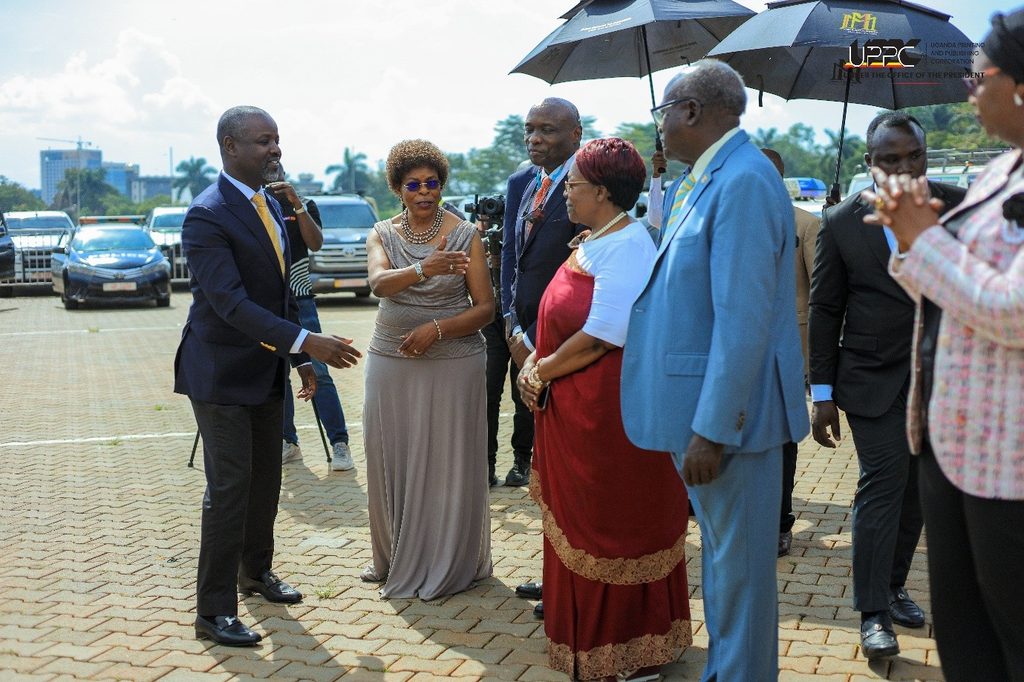
Former IGG, Hon Beti Kamya, welcomes the Guest of Honour, Rt Hon Thomas Tayebwa, who represented the President at the launch.
This is where the book’s quiet argument lands hardest. Kamya was tested by a coup, an uprising, a war, exile and the burial of his own child. And still he stayed. Today, a man need not survive a coup to abandon a family. A lost job, a difficult marriage, a season of ordinary hardship is often enough. We have built a culture in which fatherhood is treated as optional the moment it becomes inconvenient, even for men who have never faced a fraction of what Kamya endured.
Soldier of Faith is an uncomfortable measuring stick for that culture. It asks, gently but insistently: if he could do it under a coup, what is our excuse? For walking away from far smaller storms?
This is not to suggest that every family circumstance is the same, or that the challenges of fatherhood should be taken lightly. It is, rather, a call to examine how readily responsibility is abandoned when life becomes difficult. Kamya’s example invites fathers to see commitment not as a convenience, but as a responsibility that must endure beyond seasons of comfort.
The book performs a second, related correction. Kamya wore a uniform for much of his life, yet the portrait that emerges, as UPPC’s Deputy Managing Director, Rebecca Nyakairu put it at the launch, is of a soldier, church leader and family man in one, a man for whom rank never crowded out conscience. Former Vice President Edward Ssekandi’s tribute called him a man of remarkable fortitude who navigated a complicated era with absolute integrity and faith. The Deputy Speaker, representing the President, went further, arguing that Kamya’s career shows that religious conviction and professional duty can coexist, rather than compete.
In Kamya’s life, then, faith was not presented as a retreat from duty. It was a compass for carrying it out. The distinction matters: authority may grant a person power, but it is character that determines how that power is used.
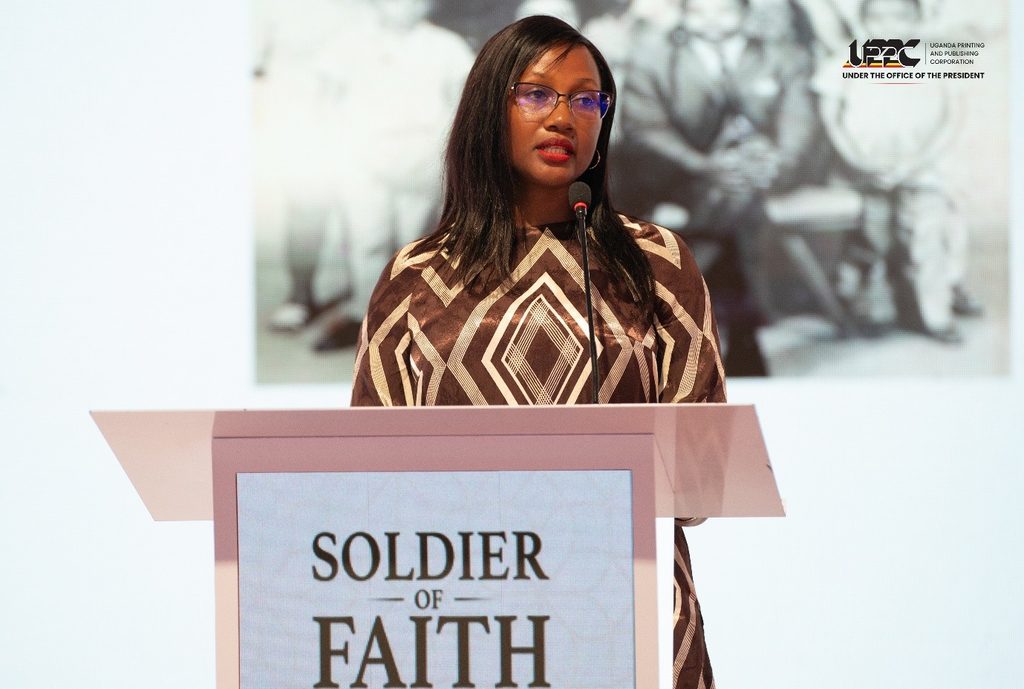
Rebecca Nyakairu, the Deputy MD-UPPC, delivers her remarks during the book launch
That argument matters because it runs so hard against the current grain. Across too much of the continent, and not only in Uganda, the uniform has also come to signal something closer to impunity than service. We read, with numbing regularity, of soldiers and men in uniform implicated in land grabs and the intimidation of civilians and associated with the machinery of tyranny rather than its opposite.
Kamya’s story is not naive about this danger. The very chapters that describe the Amin years show a military capable of terrorising its own people. What makes the book valuable is that Kamya himself, within that same institution, chose a different path, one anchored in his faith rather than the unchecked privilege of his rank. He is proof that the uniform does not determine the man. The man determines what the uniform becomes.
That is a lesson in leadership that reaches beyond the barracks. Every position of authority carries a choice: to use power in the service of others or to turn it into an instrument of personal advantage. Kamya’s example reminds us that the dignity of an office is sustained not by the title it confers, but by the conduct of the person who holds it.
None of this makes for an easy or a comfortable read. The book does not flatter its subject; it shows a man who struggled, doubted, and was tested beyond what most of us will ever experience. That honesty is precisely what gives its portrait of fatherhood and of faithful service its authority.
Soldier of Faith is, in the end, a family’s act of preservation, a record of a man who, as the Foreword puts it, remained a soldier of faith long after he had left the barracks.
But it is also, whether the family intended it or not, a rebuke delivered across sixty-four years: to the fathers who walk away from far smaller storms, and to the soldiers who have forgotten that the uniform was always meant to protect, not to plunder.
Perhaps that is the enduring power of Kamya’s story. It reminds us that discipline is not simply the ability to command, faith is not merely a declaration of belief, and fatherhood is not fulfilled by provision alone. Each is measured by what we continue to do when life gives us every reason to give up.