

By Walimbwa Moses
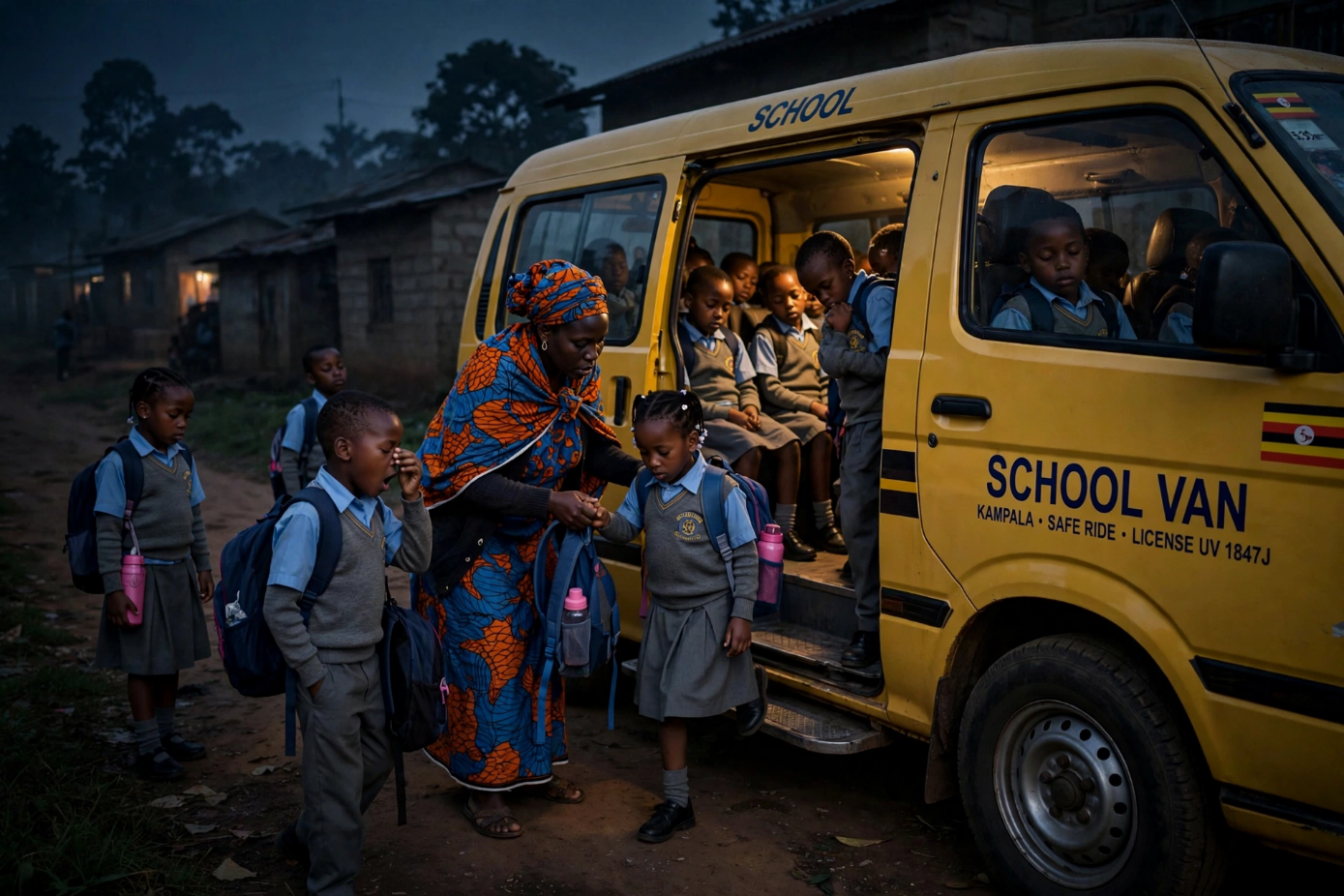
It is 5:12 a.m. in Entebbe. The compound is still dark.
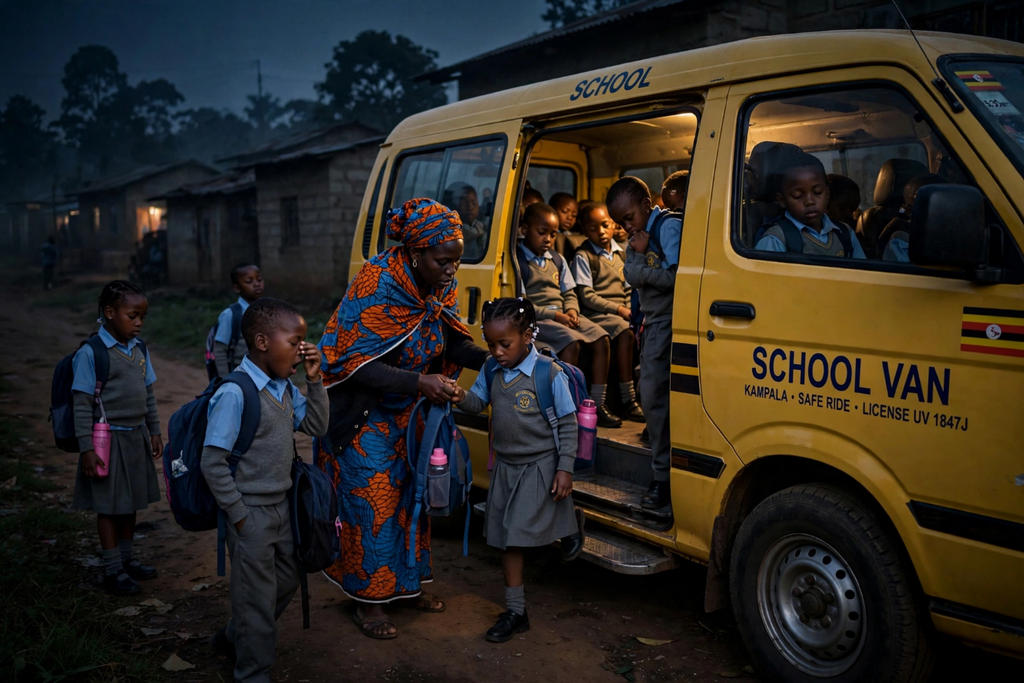
Four-year-old Jovia Nakato rubs her eyes as her mother, Prossy Namatovu, buttons her school sweater. Three alarms have already rung. Outside, a yellow school van hoots.
“If we miss the 6 o’clock van, we lose our seat,” Prossy says as she carries her sleepy daughter and her pink water bottle to the gate.
Inside the van, other children in oversized uniforms are already dozing off, their school bags resting beside them. Jovia settles into a seat and sleeps for part of the 40-minute journey to school.
Jovia’s experience raises a broader question about the changing school experience for young children: how early should a school day begin, and how can families balance academic ambitions with children’s need for rest, play and family time?
Uganda’s 2026 school calendar provides for primary and post-primary schools to operate from 8:00 a.m. to 4:30 p.m., while pre-primary schools are expected to operate from 8:00 a.m. to 12:00 p.m.
The distinction is significant because the needs of a nursery child are different from those of an older pupil.
Uganda’s Early Childhood Care and Education Policy 2025 places emphasis on quality, inclusive and sustainable early childhood services for children from birth to six years, with attention to their developmental needs.
For some parents, however, choosing a school involves more than academic considerations.
“I pay Shs120, 000 for the van, Shs80, 000 for feeding, plus fees,” says Prossy, a market vendor in Entebbe. “But if I take her to a nearby school, other parents say I am not serious. Everyone wants a top school.”
School fees, transport, meals and scholastic materials can place considerable pressure on household incomes. For parents who want to secure better opportunities for their children, declining school requirements can sometimes feel like taking a risk with their children’s future.
Yet the pressure is not only felt by families.
A nursery teacher in Entebbe, who has 12 years of experience, says some children arrive at school already tired.
“They come sleeping. The first lesson, two or three are on the desk. You wake them, they cry. You cannot teach a sleeping child,” she says. “By 10 a.m., they are hungry again.”
The teacher says academic expectations can also leave limited time for activities that support children’s wider development.
“When the school wants better grades, we are told to cover the syllabus quickly. There is no time for play or stories. Even in nursery, parents ask for homework,” she says.
Uganda’s National Teacher Policy emphasises teacher professionalism, effectiveness, accountability, innovation and creativity. It also encourages teachers to use different approaches to improve learning outcomes.
The debate over the school experience also brings back memories of earlier generations.
In Mbale, retired primary teacher Amidu Mafambi recalls a time when the school day included classroom lessons alongside physical education, agriculture, music, art and craft, debates and football.
Pupils also participated in practical activities, including making simple items such as brooms and mats and growing crops around the school.
“The system was not perfect,” Mafambi recalls. “Learning materials were scarce and classes were crowded.”
But he says practical activities and games were an important part of school life.
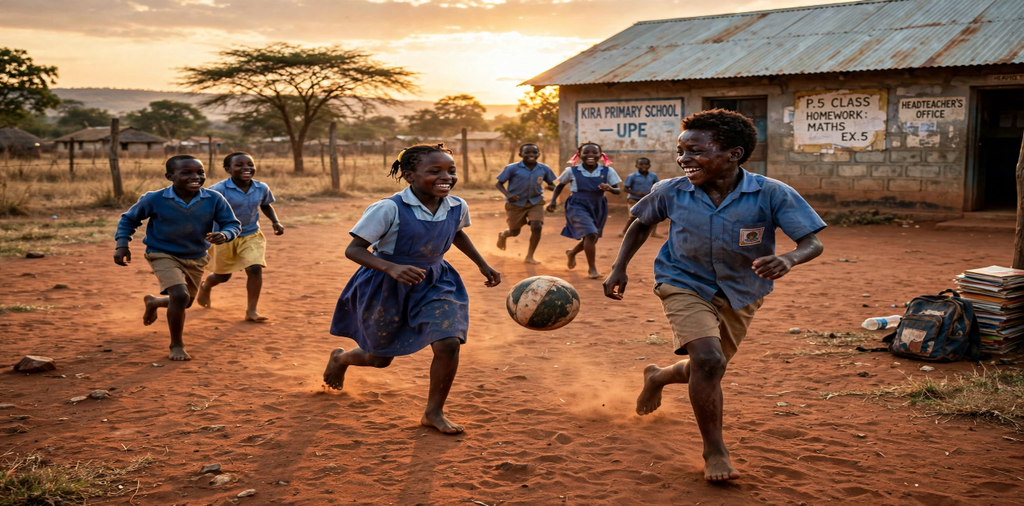
Pupils play football after school. Educationists say play and practical skills were once central to school life and remain vital for child development.
Modern education, meanwhile, has introduced opportunities that previous generations did not have. Technology has expanded access to information, learning materials have improved and children can access subjects and skills that were once difficult to find.
The challenge, therefore, may not be whether the old system was better than the new one, but how useful elements of both can be combined.
Government has also continued to emphasise access to education.
At a Bugisu Youth Symposium in Mbale City in December 2024, President Yoweri Museveni called on communities to stop imposing charges in government schools and support the implementation of Universal Primary Education and Universal Secondary Education.
“You the youths, you need to insist and say stop school charges in government schools. Wake up everybody that let us implement UPE and USE,” Museveni said.
He said Government introduced free education because many families could not afford school fees and warned that charges could contribute to children dropping out.
For families such as Prossy’s, therefore, the education question is not simply about academic performance. It is also about affordability, access, quality and the kind of experience children have while pursuing an education.
By 5 p.m., Jovia is back in Entebbe. She has a worksheet to complete. Her mother, tired from a day at the market, wants to help her.
Jovia is tired too.
At about 7 p.m., she falls asleep on the sofa, her books beside her.
Her experience does not provide a complete answer to the wider education debate. But it illustrates a question increasingly relevant to parents, teachers and school administrators: how can children receive a quality education while still having enough time for rest, play, family and other experiences that contribute to their development?
Education must prepare children for examinations and future careers. It can also help them develop confidence, creativity, practical skills, friendships and the ability to work with others.
The challenge is finding the balance.
As Uganda modernises its education system, the question may not be whether to choose between academic achievement and childhood, but how to ensure that one does not come at the unnecessary expense of the other.