

BY Caroline N
Uganda has reaffirmed its commitment to strengthening collaboration with the Intergovernmental Authority on Development (IGAD) as part of ongoing efforts to enhance disaster preparedness, climate resilience and regional development.
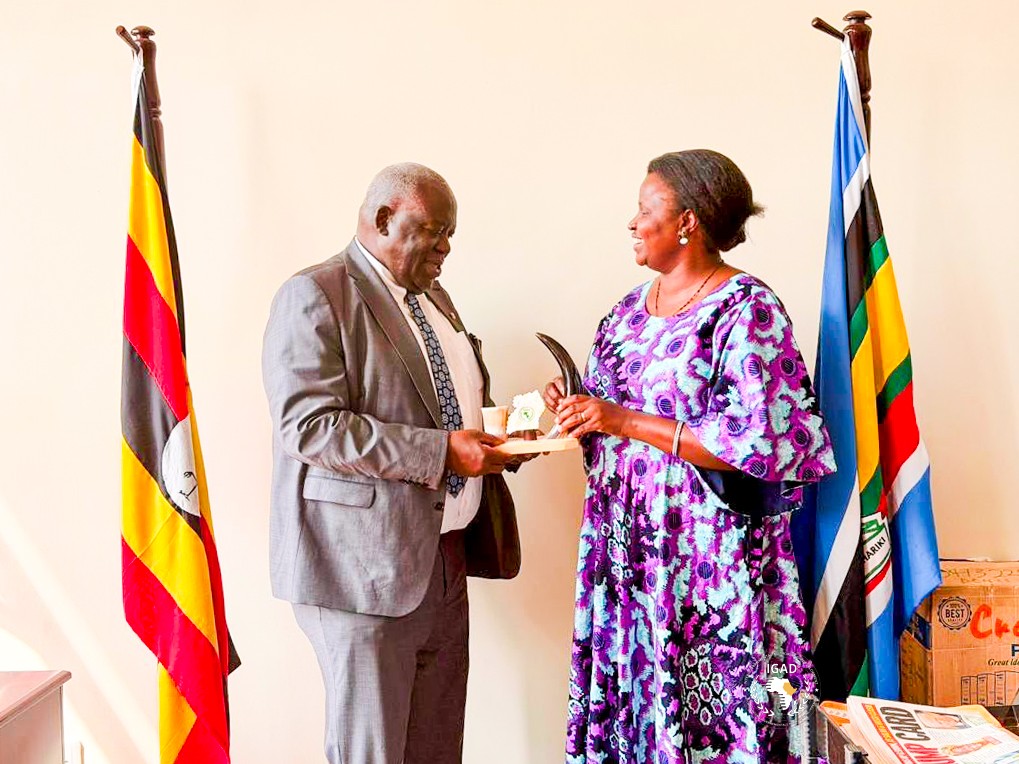
The renewed commitment was highlighted on Tuesday afternoon when the Minister of Relief, Disaster Preparedness and Refugees, Sam Engola, received the IGAD Head of Mission to Uganda, Joselyn Bigirwa, and her delegation during a courtesy visit at the Office of the Prime Minister in Kampala.
The meeting provided an opportunity for both parties to review ongoing areas of cooperation and reaffirm their shared commitment to building resilient communities capable of responding effectively to disasters and other humanitarian challenges.
During the discussions, Ms Bigirwa briefed the Minister on IGAD’s current programmes aimed at promoting regional peace and security, strengthening climate resilience, improving public health systems and advancing economic integration across the region.
She noted that these initiatives are designed to foster sustainable development while supporting Member States in addressing emerging challenges, including climate change, displacement and food insecurity.
IGAD continues to play a significant role in facilitating regional cooperation among countries in the Horn of Africa and neighbouring states.
Through its programmes, the organisation supports governments in developing practical solutions to shared challenges, including disaster risk reduction, environmental conservation, cross-border collaboration and humanitarian response.
Hon. Engola expressed appreciation for the longstanding partnership between Uganda and IGAD, acknowledging the organisation’s continued technical and financial support towards strengthening the country’s disaster preparedness and response mechanisms.
In particular, the Minister commended IGAD for its contribution to the development of Uganda’s Multi-Hazard Integrated Early Warning System and the Uganda Anticipatory Action Roadmap, two strategic initiatives aimed at improving the country’s ability to predict, prepare for and respond to disasters before they escalate into humanitarian crises.
The Minister noted that the two frameworks, officially launched last Friday, represent an important milestone in Uganda’s efforts to enhance early warning systems and adopt proactive approaches to disaster risk management.
By enabling timely access to accurate information and coordinated response planning, the initiatives are expected to minimise the impact of floods, droughts, landslides, disease outbreaks and other emergencies on vulnerable communities.
He further emphasised that effective disaster preparedness requires strong partnerships between government institutions, regional organisations and development partners. Such collaboration, he said, is essential for protecting lives, safeguarding livelihoods and promoting sustainable national development.
The courtesy visit also underscored the importance of continued engagement between Uganda and IGAD in addressing regional challenges that transcend national borders. Issues such as climate change, forced displacement and public health emergencies require coordinated action and knowledge-sharing among neighbouring countries to achieve lasting solutions.
Both parties reaffirmed their commitment to strengthening cooperation in disaster risk reduction, resilience building and regional integration. They also pledged to continue working together to support initiatives that improve community preparedness, enhance early warning systems and promote peace and stability across the region.