

By Diana N Kintu
The Office of the President has convened a Pre-APEX meeting to deliberate on the endline assessment of the implementation status of the 23 Presidential Strategic Guidelines and Directives, which constitute the Government’s priority focus areas for socio-economic transformation.
Opening the meeting, Haji Yunus Kakande, Secretary in the Office of the President and Chairperson of the APEX Platform Technical Leadership Committee, welcomed participants and emphasised the importance of evidence-based policy refinement.
“This assessment is not intended to apportion blame. Rather, it is intended to strengthen Government performance, improve implementation systems, enhance accountability, and support evidence-based Executive decision-making,” he said.
The assessment, coordinated by the APEX Platform Secretariat in collaboration with Ministries, Departments and Agencies (MDAs), as well as other core institutions, revealed that overall implementation performance remained moderate. Of the 23 directives assessed, only two were fully achieved, one performed above average, ten were rated average, eight performed below average, and two were not achieved.
While progress was recorded in areas such as electricity generation, industrial parks, irrigation infrastructure, tourism promotion, mineral exploration, judicial reforms, oil and gas development, and digitalisation, the report highlighted persistent challenges. These included weak inter-institutional coordination, delayed financing, land acquisition bottlenecks, fragmented implementation frameworks, inadequate project preparedness, and weak sustainability mechanisms.
Haji Kakande noted that many of the Government’s constraints are now structural rather than policy-related.
“The findings show that while progress has been registered across several strategic areas, overall implementation performance remained moderate and below the level required to achieve the intended transformation within the current Cabinet term,” he said.
The assessment also underscored governance and regulatory pressures arising from rapid urbanisation, environmental degradation, digital transformation, the expansion of the informal economy, and emerging technologies such as AI-generated content, which are evolving faster than existing institutional systems.
Participants were urged to sharpen their strategic observations, strengthen the practicality of recommendations, and ensure that the final report provides actionable guidance for the next phase of Government implementation.
“The assessment should be viewed as an opportunity to generate institutional learning, strengthen implementation realism, and reposition Government systems towards more integrated, results-oriented and execution-driven delivery approaches capable of supporting Uganda’s long-term transformation agenda and the 10-Fold Growth Strategy,” Haji Kakande said.
He expressed appreciation to Permanent Secretaries and Executive Directors of core APEX institutions, including the Ministry of Finance, Planning and Economic Development, the Office of the Prime Minister, the National Planning Authority, the Ministry of Public Service, the Ministry of Local Government, and Operation Wealth Creation, for their commitment to the platform and its policy reforms.
The Pre-APEX meeting is expected to validate and enrich the draft findings before the final report is submitted to higher-level APEX structures and subsequently presented to Cabinet.
Source: Office of the President – APEX Platform Secretariat, June 2026.
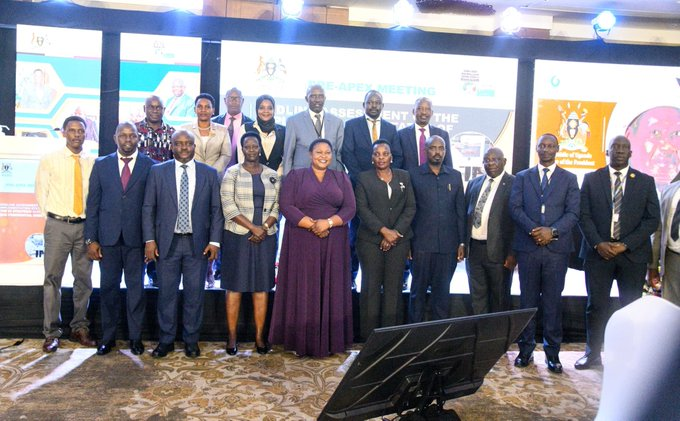
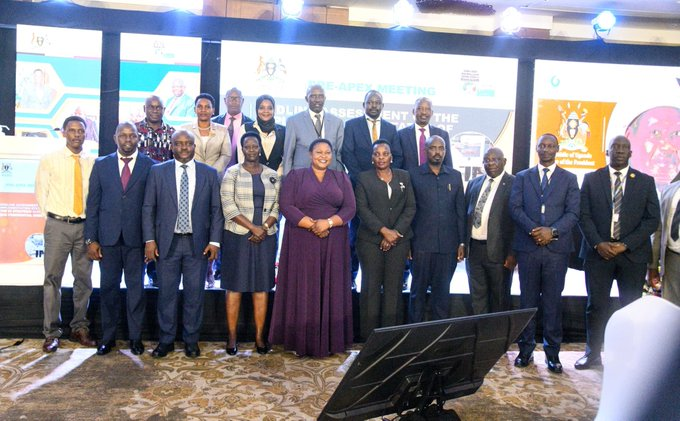
The Minister for the Presidency, Milly Babirye Babalanda, joins government leaders and technical officials for a group portrait during the Pre-APEX review meeting at the Sheraton Kampala Hotel.