

By Marvin R. Mutenyo
At 7:15 a.m., a discarded plastic bottle is pulled from a roadside trench in Kampala’s Kisenyi suburb. Three hours later, it is loaded onto a garbage truck headed for disposal. On another day, that same bottle might have remained lodged beneath a heap of polythene bags and rotting food waste, blocking the drainage channel before the next downpour.
The smell comes first.
Long before anyone sees the flooded drainage channels winding through Kisenyi, they smell them. After a night of heavy rain, black water lies trapped beneath discarded plastics, food waste and debris. Children in neatly pressed school uniforms hop from stone to stone, trying to keep their shoes dry as they make their way to school. Traders raise their goods onto wooden pallets. ‘Boda Bodas’ weave through muddy pools. The neighbourhood stirs to life, even as disease quietly finds opportunities to spread.
Now sanitation is to be a national unity
For many Ugandans, scenes like these have become an ordinary part of daily life.
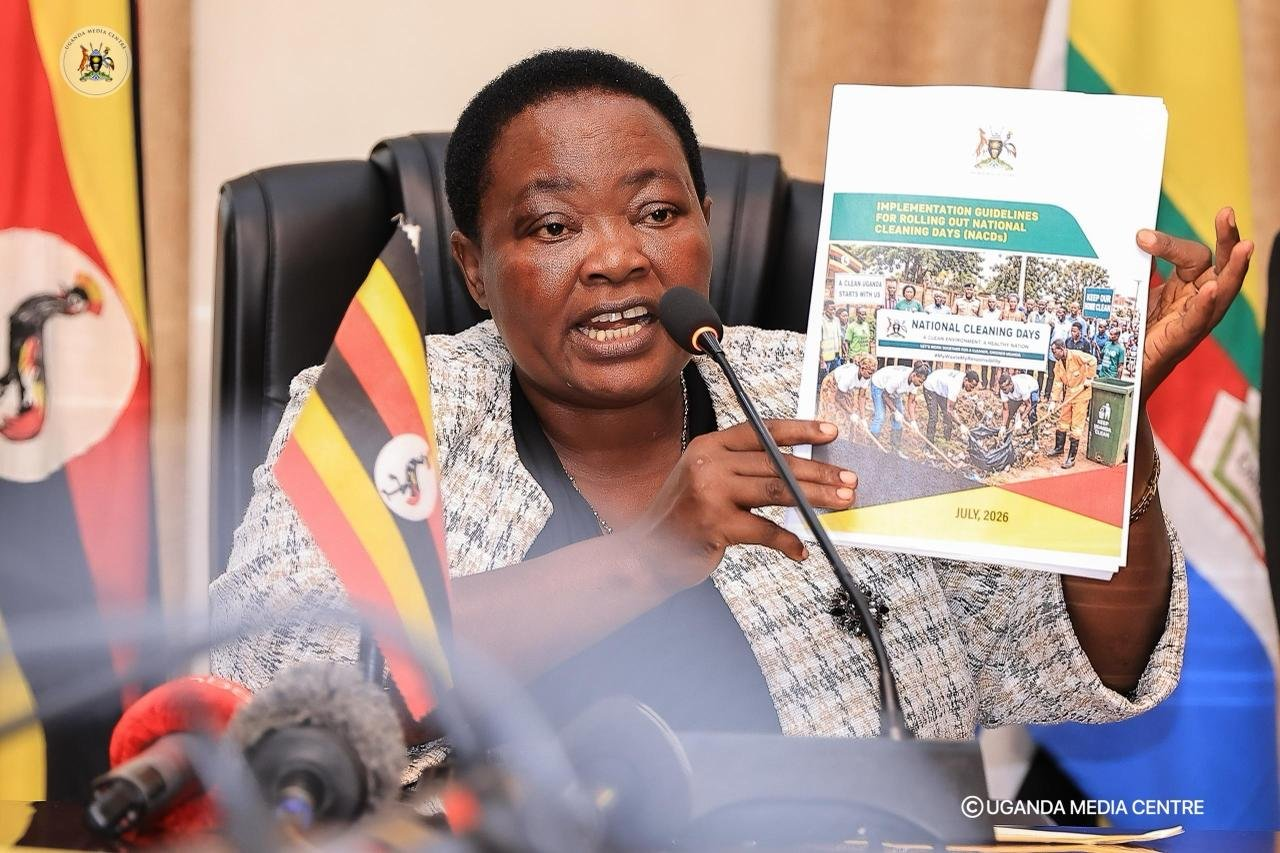
They are also the reason the Government has launched the National Cleaning Days Programme, a nationwide initiative that calls on every Ugandan to dedicate three hours, from 7:00 a.m. to 10:00 a.m. on the last Saturday of every month, to cleaning neighbourhoods, drainage channels, markets, schools, health facilities and other public spaces.
Launched by Prime Minister Rt. Hon. Robinah Nabbanja, the programme carries a simple but ambitious vision: to transform environmental sanitation by making cleanliness a shared national responsibility rather than the work of local authorities alone.
But beneath the brooms, wheelbarrows and sacks lies a much bigger question.
Can three hours every month change the habits of an entire nation?
Where the Rain Speaks First
By 8:30 on a grey morning in Kisenyi, the shelves inside a small neighbourhood pharmacy are neatly arranged, but the day has already begun. Parents arrive one after another, some carrying feverish children, others comforting little ones weakened by diarrhoea, stomach infections or malaria.
For Lilian Babirye, who has served the community for years, these mornings have become painfully predictable. She no longer waits for official health reports to tell her sanitation has become a problem. The rain tells her first.
“After every heavy rain, we begin seeing more cases of diarrhoea, stomach infections and malaria. It has become a pattern. Many of these illnesses could have been prevented if our surroundings were cleaner,” she says as she arranges medicine behind the counter.
She pauses, looks towards the drainage outside, then quietly adds: “People usually come looking for medicine, but sometimes the best medicine isn’t found in these bottles. It begins with a clean environment.”
Her words echo what health experts have warned for years. Poor sanitation is not simply unpleasant. It is deadly.
Government estimates that about 75% of diseases affecting Ugandans are preventable, with many linked to poor sanitation, unsafe water and poor hygiene. According to the Ministry of Health, dozens of children die every day from diseases associated with inadequate sanitation and hygiene, illnesses that are largely preventable through cleaner environments and safer practices.
“When children fall sick because of poor hygiene,” Babirye explains, “families suffer twice. They spend money on treatment, children miss school, and parents lose valuable time they could have spent earning a living.”
For her, sanitation is no longer an environmental conversation. It is a public health emergency.
When Dirty Drains Empty Shops
Just a few streets away, plastics trader Kenneth Kizito confronts the same problem from a different perspective. Whenever heavy rain falls, customers stop at the edge of the floodwater, look towards his shop and quietly turn away.
Before making a sale, he must first remove rubbish blocking the drainage outside his business.
“When the drainage blocks, the water comes into our shops. Our goods get damaged, customers disappear, and business suffers,” Kizito says.
“It doesn’t matter who threw the rubbish there. Everyone pays the price.” Looking towards the blocked trench, he shakes his head.
“Many people think throwing away one plastic bottle doesn’t matter. But thousands of bottles later, the drainage can no longer breathe. When it rains, all that rubbish comes back to us.”
His experience reflects another truth often overlooked. Poor sanitation is not only a health issue. It is also an economic one. Clean trading centres attract customers and flooded businesses lose income.
Tourists remember clean cities long after they have forgotten landmarks. Investors too are more likely to trust communities that value order and public health. Cleanliness is not merely about appearance. It is an investment in economic growth.
A Nation at a Turning Point
The stories of Babirye and Kizito are repeated across Uganda. As towns expand and urban populations grow, waste management systems are struggling to keep pace.
Kampala alone generates between 2,000 and 2,500 tonnes of solid waste every day, yet only about half is collected and safely disposed of. The rest often finds its way into drainage channels, wetlands and illegal dumping sites, waiting for the next rainfall to return it to homes, schools and businesses.
Behind every statistic is a family, behind every blocked drainage channel is a child at risk of disease and behind every flooded market is a trader wondering how to recover another day’s income. These realities prompted Government to launch the National Cleaning Days Programme.
Speaking at the launch in Kisenyi, Prime Minister Robinah Nabbanja described the initiative as a Whole-of-Government and Whole-of-Society Programme, emphasising that environmental cleanliness cannot be achieved by government alone.
“Keeping our environment clean is a civic responsibility,” she said, urging Ugandans to participate actively and reminding citizens that “For three hours, let Uganda stop and clean.”
Her message was straightforward. Government can coordinate, districts can mobilise communities, environmental officers can enforce regulations, but no institution can keep Uganda clean if citizens continue throwing rubbish into drainage channels.
The programme’s theme captures that shared responsibility: “A Clean Uganda is Everybody’s Responsibility.”Countries celebrated today for their cleanliness once faced many of the same challenges Uganda faces now.
What If We Picked a Leaf from Other Countries
Every month in Rwanda, communities participate in Umuganda, a nationwide community service programme that has become part of the country’s identity. Roads are repaired, public spaces cleaned, drainage channels cleared and neighbours work side by side. Businesses pause. Communities unite. The exercise has become more than sanitation, it has become a symbol of citizenship.
In Japan, children learn the same lesson from an early age. At the end of every school day, pupils clean their classrooms, corridors and toilets themselves. The lesson extends beyond hygiene. It teaches responsibility, humility and respect for shared spaces.
Singapore took another path. As the young nation modernised in the 1960s, cleanliness became central to national development. Government invested heavily in waste management, introduced strict anti-littering laws and sustained public education campaigns. Decades later, Singapore consistently ranks among the cleanest cities in the world, not because sanitation workers clean constantly, but because citizens have embraced cleanliness as a way of life.
Even New York City, despite spending billions of dollars annually managing waste, continues to rely on residents, businesses and neighbourhood organisations to keep public spaces clean. The lesson is universal. The responsibility begins with citizens.
Why Three Hours Will Matter
Some critics may dismiss National Cleaning Days as another government campaign, but history suggests otherwise. Behavioural scientists have long argued that lasting habits are built through repetition. Communities develop culture when positive actions become routine rather than exceptional.
That is precisely why Government has chosen to institutionalise National Cleaning Days every month instead of organising a once-off national clean-up. The objective is not simply to collect rubbish. It is to cultivate responsible citizens.
If sustained, the programme could reduce preventable disease, lower healthcare costs, protect public infrastructure, improve tourism, strengthen investor confidence and build stronger communities.
Beyond the Broom
For Babirye, success will not be measured by how many people pick up brooms on one Saturday morning. It will be measured by fewer children arriving at her pharmacy with preventable illnesses.
For Kizito, success will mean welcoming customers instead of sweeping floodwater from his shop. The next time rain falls over Kisenyi, the drainage channels will face the same test.
Whether they overflow again may depend less on the intensity of the storm than on the choices people make before it arrives. The plastic bottle dropped beside the road, the rubbish thrown into a trench, the drain no one thought to clear.
The programme’s success will not be measured by the tonnes of rubbish collected on Saturday. It will be measured by how little rubbish is thrown away on Monday. History may not remember the National Cleaning Days Programme simply because Ugandans picked up brooms. It may remember it because a nation chose to redefine citizenship.
The real transformation begins in the mind. And perhaps the next time a plastic bottle is picked from a roadside trench in Kisenyi, it will not simply be another piece of rubbish removed. It will be a small sign that Uganda has begun to build something far greater than cleaner streets.
It will have begun to build a culture of responsibility.