

By DianaN.Kintu
The Executive Director of the Uganda Communications Commission (UCC), Mr Nyombi Thembo, has called for a renewed focus on digital innovation as a key driver in transforming and revitalising Africa’s postal services.
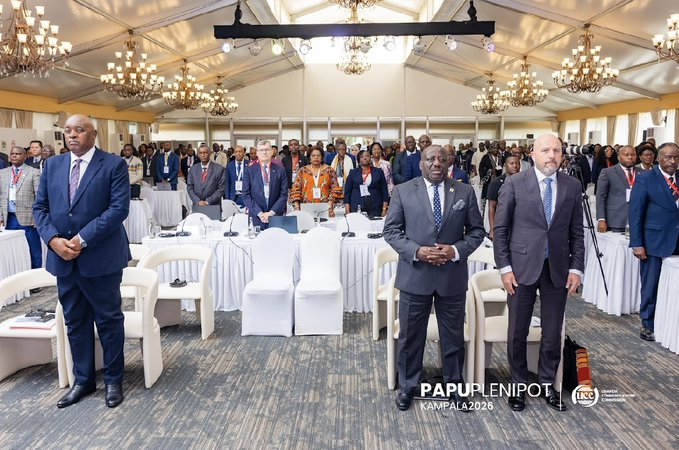
He made the remarks during the 11th Ordinary Session of the Pan African Postal Union (PAPU) Plenipotentiary Conference held at Lake Victoria Serena Hotel. The high-level gathering brought together policymakers, regulators, and postal operators from across the continent to deliberate on the future of the postal sector in an increasingly digital world.
Mr Thembo, who was joined by the Rt. Hon. Prime Minister and the Minister of ICT and National Guidance, described the conference as a defining moment for Africa’s postal ecosystem. He noted that while traditional postal services had long been perceived to be in decline due to the rise of digital communication, emerging global trends present a new opportunity for reinvention.
“Although many once predicted the decline of postal services due to the shift away from traditional letter-writing, we are now witnessing a compelling counter-narrative,” he said. “The sector is not dying; it is evolving.”
He explained that the rapid growth of global e-commerce has repositioned postal networks as essential infrastructure for logistics, trade facilitation, and last-mile delivery services. With more consumers and businesses relying on online platforms, the demand for efficient, reliable delivery systems has significantly increased.
“We are no longer just transporting envelopes; we are moving value, enabling trade, and promoting digital inclusion for all Ugandans,” Mr Thembo emphasised. He added that postal services now play a central role in connecting rural and urban economies, thereby supporting inclusive national development.
At the national level, UCC, in collaboration with Posta Uganda, is already implementing a comprehensive roadmap aimed at modernising postal services to align with global trends. Mr Thembo outlined four key pillars underpinning this strategy.
These include the full digitisation of postal services to enhance efficiency and customer experience; the rollout of a robust National Addressing System to improve delivery accuracy and accessibility; the modernisation of regulatory frameworks to foster competition and innovation; and the integration of postal networks with digital financial services to expand access to financial inclusion.
“These initiatives are designed to ensure that our infrastructure remains resilient, efficient, and relevant in a fast-paced global market,” he noted.
Mr Thembo further underscored the importance of continental coordination in achieving meaningful transformation. He observed that for Africa to compete effectively on the global stage, there is a need for harmonised addressing systems, streamlined customs procedures, and interoperable digital tracking platforms.
Through collaborative platforms such as PAPU and the Universal Postal Union, African countries are already working towards strengthening efficiency, transparency, and reliability in cross-border postal and delivery services.
“We are repositioning the African postal operator not merely as a carrier of physical mail, but as a cornerstone of the African Continental Free Trade Area,” Mr Thembo added, highlighting the strategic role of postal services in facilitating intra-African trade.
Delegates at the conference expressed optimism that the resolutions adopted in Kampala will serve as a blueprint for building a modern, technology-driven postal ecosystem. Such a system, they noted, has the potential to transform postal networks into a key engine for economic integration, digital transformation, and shared prosperity across the continent.