

By Diana N. Kintu
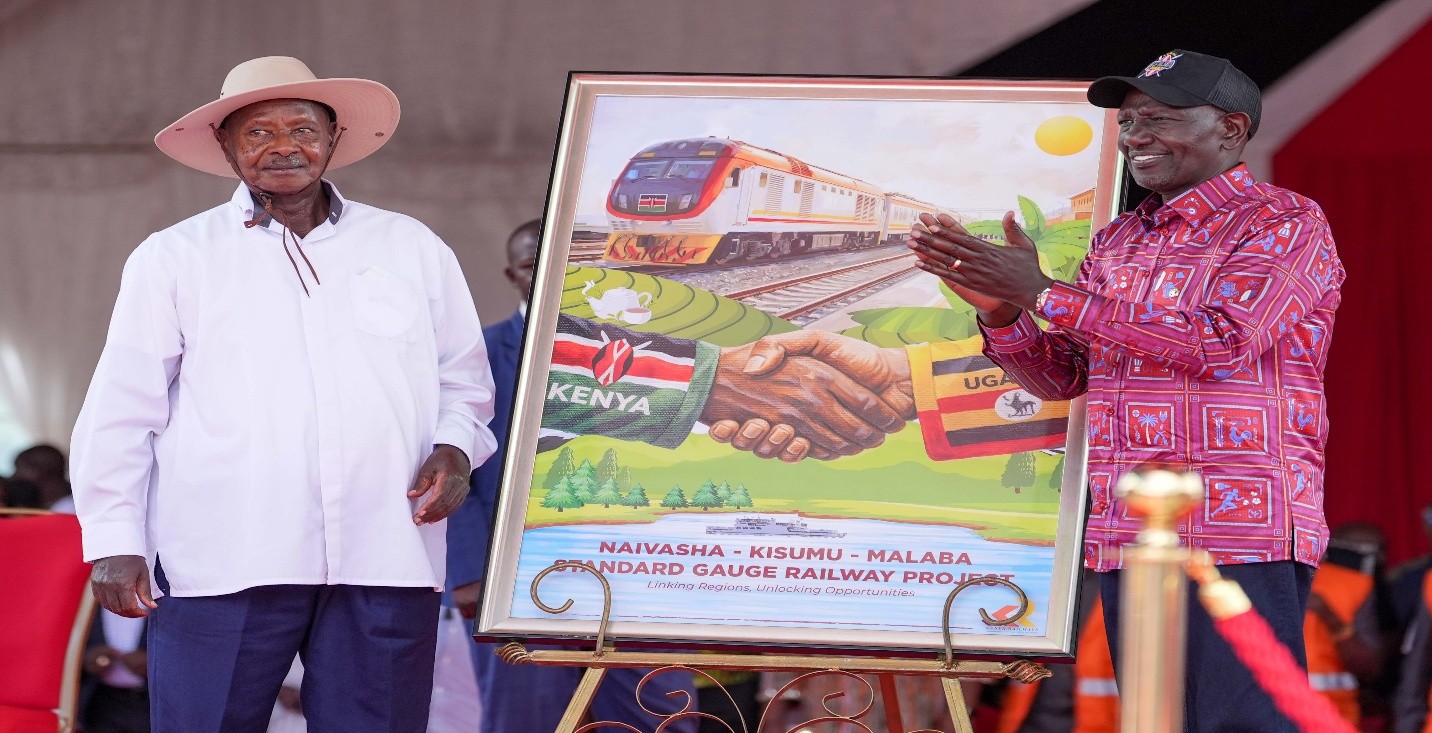
Uganda and Kenya have taken a significant step towards strengthening regional infrastructure and trade following the launch of the Naivasha–Kisumu–Malaba Standard Gauge Railway (SGR), a project expected to transform freight transport across East Africa.
President Yoweri Kaguta Museveni joined his Kenyan counterpart, William Ruto, at the launch, where both leaders underscored the importance of the railway in enhancing regional integration and reducing the cost of doing business.
Speaking at the event, President Museveni described the SGR as a strategic investment aimed at addressing inefficiencies in Uganda’s transport system, which he said has for decades relied heavily on road transport.
“Our transport system has been irrational and wasteful, with nearly all cargo concentrated on roads,” he said. “Our plan is to transfer all heavy cargo to the railway, petroleum products to pipelines and water transport, and leave roads for passengers and light cargo.”
The Naivasha–Kisumu–Malaba SGR forms part of a broader regional infrastructure network designed to link the Kenyan port city of Mombasa to inland destinations across East Africa, including Uganda and beyond. Once completed, the railway is expected to significantly ease the movement of goods, reduce transit time, and lower transport costs for businesses.
President Museveni emphasised that high transport costs remain one of the key barriers to Africa’s industrial growth and competitiveness, alongside the cost of electricity and access to affordable financing.
“For Africa to survive, we must produce high-quality goods that are affordable,” he said. “The high cost drivers are transport, electricity, and the cost of money. If we do not address these, our goods will not be competitive, even within Africa.”
He added that improving transport efficiency through rail and pipeline infrastructure would not only reduce costs but also protect road networks from damage caused by heavy cargo trucks.
On Uganda’s planned railway expansion, President Museveni outlined an ambitious network that will extend the SGR deeper into the region. He said Uganda is set to prioritise the construction of its section from Malaba to Kampala, with further extensions to Kasese and Mpondwe, providing a critical link to the Democratic Republic of Congo (DRC).
“We are going to push our section from Malaba to Kampala, then to Kasese and Mpondwe, linking to the DRC,” he said. “We are also working on the railway from Tororo to Gulu, then Nimule to Juba, as well as the line from Bihanga to Kigali.”
According to the Ministry of Works and Transport, Uganda’s Malaba–Kampala SGR section, covering approximately 272 kilometres, is already under implementation and is expected to seamlessly connect to the Kisumu–Malaba line in Kenya.
The Ministry noted that once the entire network is complete, cargo will be transported directly by rail from Mombasa to Kampala, marking a major shift in regional logistics.
“Cargo will move directly from Mombasa to Kampala by rail, redefining freight movement by easing pressure on highways and improving transit efficiency,” the Ministry said in a statement.
Experts say the development could significantly enhance trade within the East African region by reducing reliance on road transport, cutting fuel costs, and minimising delays at border points.
President Museveni concluded by reiterating the long-term benefits of shifting bulk cargo to rail and alternative transport systems.
“By shifting bulk cargo from roads to rail and pipelines, we reduce transport costs, protect infrastructure, and improve efficiency,” he said.
The SGR project is widely seen as a cornerstone of regional integration efforts, with the potential to boost intra-African trade, support industrialisation, and strengthen economic ties among countries in the East African Community.