

By Ssenkayi Ezra Marvin
Uganda’s Chief Justice, Alfonse Chigamoy Owiny-Dollo, has officially retired, bringing to an end a distinguished legal career spanning more than 40 years in public service and marking a significant transition within the country’s Judiciary.
Justice Owiny-Dollo retired upon attaining the constitutional retirement age of 70, in accordance with Article 144 of the Constitution of the Republic of Uganda. He has served as Chief Justice since August 2020, a tenure marked by institutional reform, judicial modernisation and efforts to improve access to justice.
His career in the legal profession began in the early 1980s following his admission to the Bar. Over the decades, he rose steadily through the ranks of the Judiciary, serving as a High Court Judge, Justice of the Court of Appeal and Supreme Court, and later as Deputy Chief Justice before his elevation to the country’s highest judicial office.
In addition to his work on the bench, Justice Owiny-Dollo previously served as Chairperson of the Judicial Service Commission, where he played a central role in judicial appointments, discipline and institutional governance.
Appointed Chief Justice at a challenging time, his leadership coincided with efforts to address longstanding case backlogs, manage the impact of the COVID-19 pandemic on court operations, and respond to growing public demand for efficient and transparent justice delivery.
During his tenure, the Judiciary advanced a number of reforms, including the expansion of alternative dispute resolution mechanisms, increased use of technology in court processes and renewed emphasis on judicial accountability and ethics. Justice Owiny-Dollo consistently underscored the importance of judicial independence while highlighting the Judiciary’s role in supporting constitutional governance and national stability.
Access to justice was a central pillar of his leadership. Under his stewardship, the Judiciary expanded outreach programmes, mobile court initiatives and efforts to decentralise judicial services, particularly for vulnerable and marginalised communities. He also supported capacity-building initiatives for judicial officers and staff to strengthen professionalism and public confidence in the courts.
His retirement triggers the constitutional process for appointing a successor. The Judicial Service Commission is expected to undertake the required procedures to recommend a candidate for appointment by the President, subject to parliamentary approval.
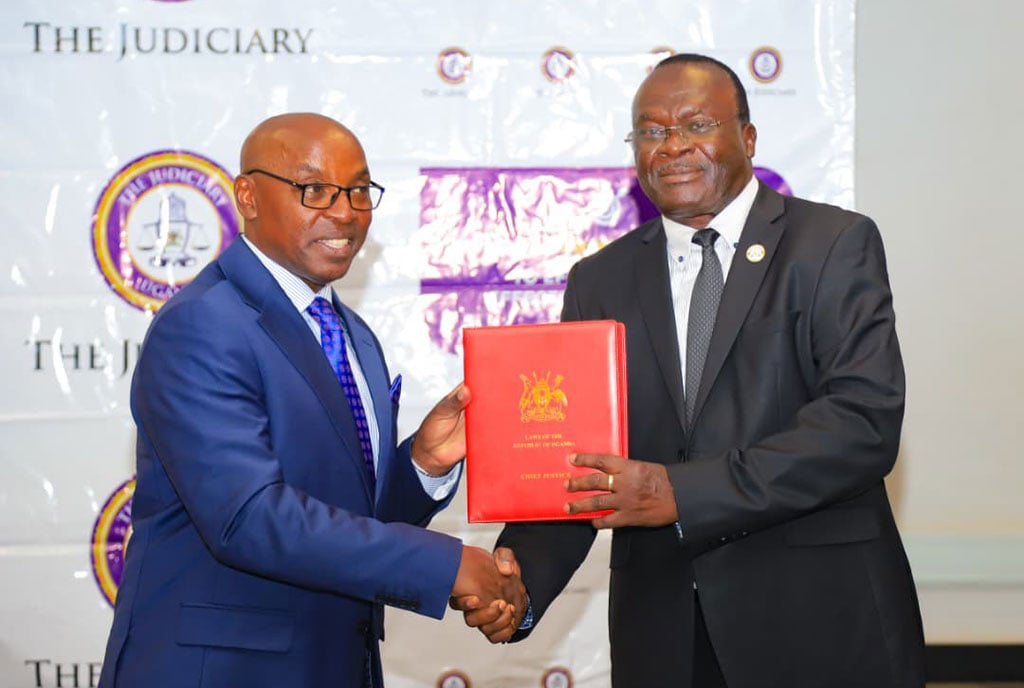
In the interim, Justice Owiny-Dollo has formally handed over office to the Deputy Chief Justice, Dr Flavian Zeija, who will oversee the continuity of judicial operations during the transition period. The Judiciary has assured the public that court services will continue without disruption.
As he leaves office, Justice Owiny-Dollo is widely recognised for his long service, institutional leadership and commitment to upholding the rule of law. His departure marks the close of a significant chapter in Uganda’s judicial history, even as the Judiciary continues its mandate to administer justice in accordance with the Constitution.