

By Diana.N.Kintu
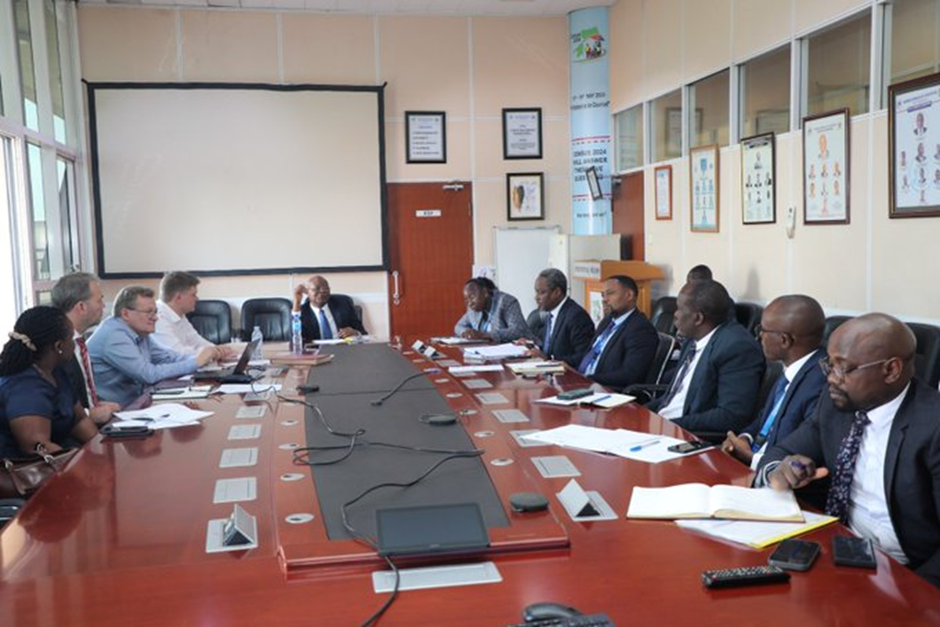
Uganda has taken a significant step toward strengthening its National Statistical System through a new long-term partnership between the Uganda Bureau of Statistics (UBOS) and Statistics Denmark. The collaboration was initiated during a high-level meeting in Kampala, where representatives from both institutions engaged in extensive discussions aimed at enhancing Uganda’s capacity in statistical production, data management, and evidence-based planning.
The Danish delegation, comprising officials from Statistics Denmark and the Embassy of Denmark in Uganda, met with UBOS leadership to outline a cooperative framework intended to support Uganda’s statistical priorities through 2035. The team was led by Jaspa Ellemose Jensen, accompanied by colleagues Jacob Jepsen, Michael Skoubo, and Sarah Fortunate. They were received by Dr Chris N. Mukiza, the Executive Director of UBOS, who emphasised the timeliness and importance of the partnership.
Jensen explained that the collaboration seeks to strengthen the overall coordination and performance of Uganda’s National Statistical System, which brings together UBOS, government ministries, departments, agencies, local governments, and private sector stakeholders responsible for producing statistical data. He noted that the initiative is expected to increase funding for statistical activities, deepen political support for data-driven governance, and enhance the production and use of high-quality statistics that meet international standards. According to Jensen, the partnership will help promote a culture where public institutions rely more on evidence-based decision-making, improving policy formulation and implementation at all levels of government.
Central to the discussions was Uganda’s ongoing drive to digitise administrative data systems. Dr Mukiza highlighted that integrating essential national datasets such as birth and death registrations, civil status records, and other administrative sources with National Identification Numbers (NINs) will significantly boost the accuracy, consistency, and reliability of official statistics. He explained that digitised and interconnected systems would reduce duplication, minimise data gaps, and improve service delivery, especially in sectors such as health, education, agriculture, and social protection. In his closing remarks, Dr Mukiza called on both sides to remain committed, stressing that the partnership must be “impactful, productive, and successfully implemented” to deliver measurable results for Uganda’s development.
The new cooperation will focus on three strategic pillars: capacity building for Ugandan statisticians and data professionals, strengthening bilateral ties between UBOS and Statistics Denmark, and promoting public-private partnerships that expand the country’s statistical production capabilities. The inclusion of private sector actors is expected to help diversify data sources, promote innovation, and increase the overall responsiveness of Uganda’s statistical system.
A key component of the partnership is its emphasis on climate change statistics. As environmental challenges intensify, Uganda has recognised the need for robust climate-related data to guide mitigation and adaptation strategies. The collaboration will support UBOS in expanding its capacity to collect, analyse, and disseminate environmental and climate statistics, which have become essential for national planning, disaster preparedness, and reporting on international commitments such as the Sustainable Development Goals (SDGs).
In the coming days, a technical team from UBOS led by Thomas Rutaro, the Director of Methodology and Statistical Coordination Services, will work closely with the Danish experts to develop a detailed strategy and implementation roadmap. This plan will set out clear milestones for strengthening Uganda’s statistical capacity and will guide the country’s data innovation agenda over the next decade.
The partnership represents a major investment in Uganda’s data ecosystem at a time when quality statistics are increasingly seen as critical to economic transformation and sustainable development. By leveraging Denmark’s long-standing expertise in advanced statistical systems, UBOS aims to improve the accessibility, accuracy, and relevance of official statistics for policymakers, businesses, and citizens. With the new collaboration now underway, both countries anticipate a strengthened statistical foundation that will support Uganda’s development priorities and enhance its global competitiveness through reliable and timely data.