

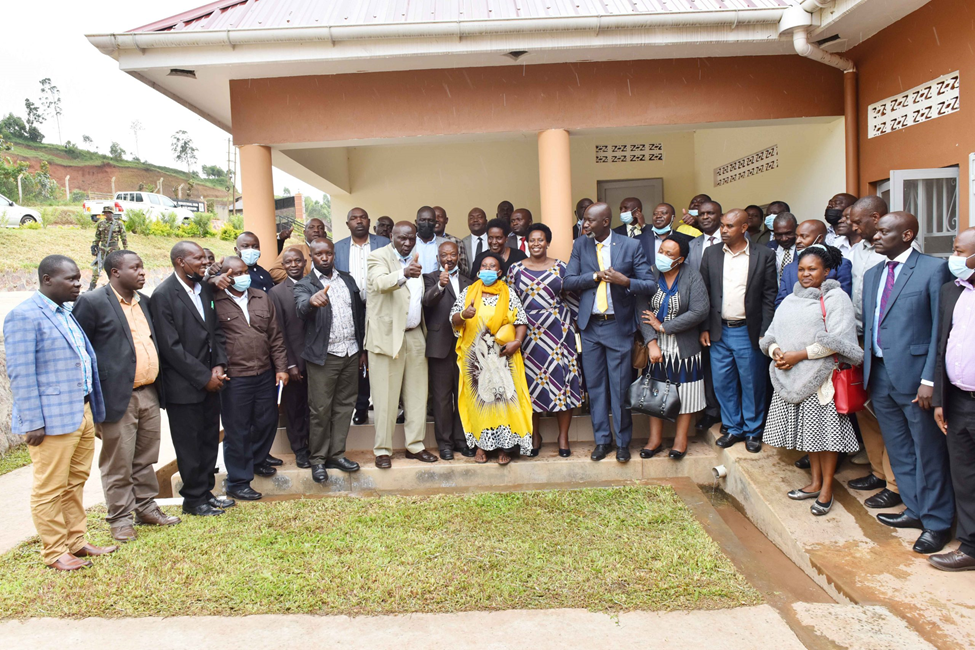
By Caroline. N.
The Government of Uganda is set to roll out an ambitious Industrial Hub in the Kigezi sub-region, a project that President Yoweri Kaguta Museveni says will support wealth creation, value addition, and job opportunities for more than 16,000 youths and households. The initiative is part of the broader national strategy aimed at transforming Uganda from a raw-material–exporting economy into one driven by manufacturing, agro-industrialization, and skills development.
Speaking during a regional engagement with leaders and investors, President Museveni emphasised that Kigezi, like many other regions in Uganda, has abundant resources that have not been fully commercialised. According to him, the construction of the Kigezi Industrial Hub will unlock production potential by enabling young people to acquire practical skills while offering a ready platform for value addition to locally available commodities.
He explained that the Industrial Hub will be part of the network of zonal industrial centres being established across the country, each designed to train youth aged 18 to 35 in various fields such as carpentry, welding, tailoring, bakery, agriculture, shoemaking, and manufacturing. The facilities will also accommodate small and medium-scale processing plants to ensure that training is directly linked to production and income generation.
“In every region, we want a hub where our young people can gain productive skills, produce goods needed by the local and export markets, and earn meaningful livelihoods,” the President noted. He stressed that for industrialisation to succeed, Uganda must aggressively move toward value addition on agricultural products such as coffee, fruits, dairy, Irish potatoes, tea, and cereals—all of which thrive in Kigezi.
The Kigezi Industrial Hub is expected to employ young people in both direct and indirect roles. Over 16,000 job opportunities are anticipated once the training centres, workshops, and production lines become fully operational. Hundreds more are expected to benefit from feeder industries, supply chains, transportation, and support services that will grow around the hub.
Local district leaders welcomed the development with optimism, pointing out that Kigezi has long suffered from limited industrial investments, despite having a hardworking population and rich agricultural potential. Many young people migrate from Kabale, Kisoro, Kanungu, Rubanda, Rukiga, and Rukungiri to urban centres like Kampala, Mbarara, and Mbale in search of employment. Leaders expressed hope that the new industrial hub would help reverse this trend by keeping skilled youth productively engaged within the region.
The government has also committed to equipping the hub with modern machinery and access to market linkages through the Parish Development Model (PDM), Emyooga, and other value-chain financing programs. Additionally, the Uganda Investment Authority and private partners will support incubation of enterprises, helping trainees transition from students to business owners and employers.
Museveni urged parents and community leaders to encourage young people to enrol in technical and industrial programs rather than only pursuing white-collar-focused education. He reiterated that wealth creation must be based on enterprise, productivity, and skills.
“The youth who go through these hubs should not just look for jobs—but should become manufacturers, processors, and entrepreneurs who meet market needs,” he advised.
Analysts believe that if the Kigezi Industrial Hub is fully implemented and supported, it could significantly raise household incomes, reduce youth unemployment, and strengthen the region’s contribution to national GDP. Many also argue that such hubs offer a sustainable solution to youth unemployment compared to short-term cash handouts.
The establishment of the hub is scheduled to begin soon, with land already earmarked and preliminary planning underway. Once completed, the hub is expected to become a major centre of local production, skills training, and innovation—placing Kigezi among the emerging industrial contributors to Uganda’s development agenda.
As Museveni reaffirmed, the long-term vision is to ensure that every region in Uganda has the capacity to produce, add value, create jobs, and transform livelihoods, all contributing toward a modern, self-sustaining economy.