

By Diana N. Kintu
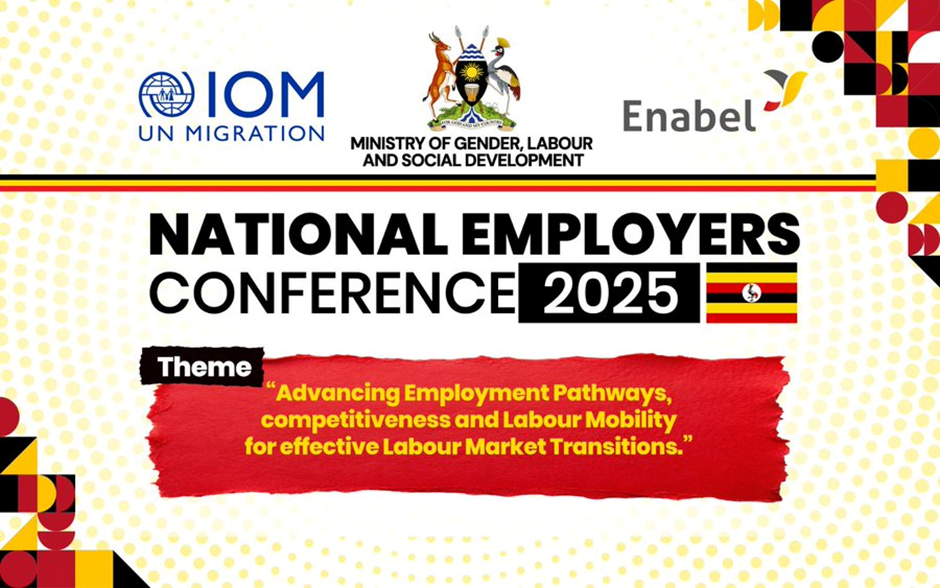
The Government of Uganda has today convened a major national conference aimed at addressing persistent unemployment challenges and the widening gap between the skills employers need and those possessed by jobseekers. The National Employers’ Conference and Exhibition is underway at Mestil Hotel and Residences, bringing together policymakers, employers, training institutions, and jobseekers from across the country. The event is being officiated by the Right Honourable Prime Minister.
Organised by the Ministry of Gender, Labour and Social Development, the conference is being held in partnership with the International Organisation for Migration (IOM), the Federation of Uganda Employers (FUE), and the Kampala Capital City Authority (KCCA). It is positioned as a high-level platform to evaluate the state of Uganda’s labour market and develop solutions to improve employment outcomes for citizens, especially young people.
This year’s conference is themed “Advancing Employment Pathways and Competitiveness through Career Guidance, Innovation, Digitisation, Partnerships and Labour Mobility.” The focus reflects Uganda’s long-term strategy to build a skilled, competitive, and globally relevant workforce capable of driving national growth and economic transformation.
Uganda faces a pressing labour market challenge, with an estimated 700,000 young people entering the workforce annually. Although the economy has expanded in recent decades, job creation has not kept pace with the growing number of jobseekers. Many young Ugandans struggle to secure meaningful employment due to limited information on available opportunities, weak linkages with employers, and inadequate career guidance.
Surveys have repeatedly shown that most Ugandans find work through informal channels such as friends, family, or word-of-mouth networks. Only a few secure jobs through structured systems like advertisements, job boards, or recruitment agencies. This reliance on informal channels often leaves qualified candidates without access to reliable job information, placing them at a disadvantage in the labour market.
At the same time, employers are grappling with their own challenges. Many companies report that job applicants frequently lack the specific skills needed for modern workplaces. Sectors such as manufacturing, ICT, and oil and gas continue to experience shortages of specialised technical expertise. Employers also cite limited adoption of digital tools and technologies in the workforce as a barrier to innovation and productivity.
Against this backdrop, the conference serves as a much-needed platform for dialogue between government, employers, and jobseekers. Throughout the day, participants engaged in panel discussions, presentations, and networking sessions focused on strengthening the future of work in Uganda. Topics include expanding labour mobility opportunities, embracing digital transformation, enhancing workplace productivity, and supporting Ugandans returning from work abroad through reintegration and training programs.
A major highlight of the event is a multi-sector exhibition, where leading companies are showcasing job openings, internships, business solutions, and technological innovations. Exhibitors from oil and gas, ICT, agriculture, manufacturing, and other key economic sectors are participating. Additionally, Ugandan migrant workers who have returned home after receiving specialised skills training are showcasing their practical competencies, demonstrating the value of structured labour mobility programs.
The Government has emphasised the importance of collaboration in solving the country’s employment challenges. Employers, training institutions, development partners, and jobseekers have been urged to actively participate in such national forums to share knowledge, strengthen networks, and contribute to a labour market where every Ugandan has the opportunity to secure decent and productive employment.
As the Conference continues, stakeholders are expected to develop recommendations and commitments aimed at building a more efficient and inclusive job market—one that prepares Uganda’s youth for the evolving demands of the global economy while contributing to national development.