

By Walimbwa Moses
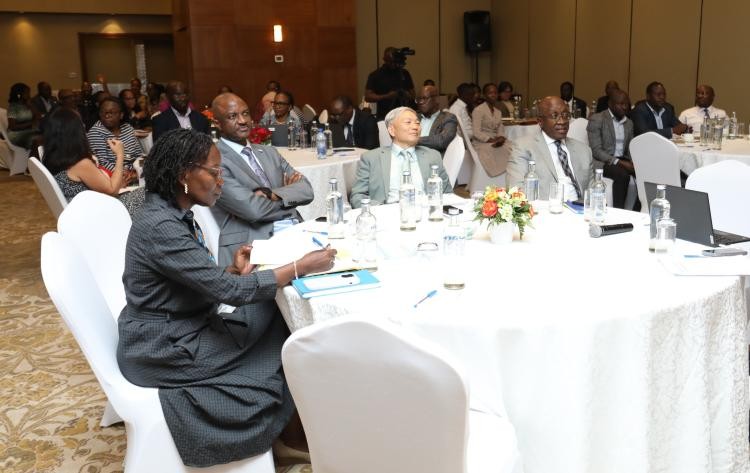
Ugandan Government and World Bank officials during the Country Portfolio Performance Review held in Kampala to assess the implementation of the US$4.6 billion development portfolio.
Uganda and the World Bank have agreed to speed up implementation of a US$4.6 billion development portfolio covering 18 operations, amid concerns over delays in putting approved projects into action.
The agreement followed a Uganda–World Bank Country Portfolio Performance Review held at Sheraton Hotel in Kampala on September 16, 2026. The meeting assessed progress of World Bank-supported projects and discussed challenges affecting implementation.
Permanent Secretary and Secretary to the Treasury Ramathan Ggoobi said Government was assessing whether delays were caused by funding constraints or project management problems, including procurement, designs, land acquisition, counterpart funding, approvals and contract management.
“We are going to get quantified answers that separate the fiscal constraint from the management constraint,” Ggoobi said.
He said some projects were committed before they were ready to start, with physical works in some cases beginning only in the third year. This, he said, leaves limited time to complete planned activities and increases the risk of extensions, unfinished works and additional costs.
Ggoobi said Government had strengthened project screening to ensure projects meet Public Investment Management System requirements before negotiations. Financing agreements will also require implementation-readiness conditions, including approved procurement plans, completed environmental and social safeguards and acquisition of necessary rights-of-way.
He also highlighted electronic government procurement as a measure to improve efficiency, transparency and accountability.
Nine projects are scheduled to close in 2027 and 2028. Ggoobi said projects unlikely to be completed within the remaining period should be considered for restructuring, scaling down or cancellation, while extensions should be limited to essential ongoing contractual obligations.
Qimiao Fan, World Bank Division Director for Uganda, Kenya, Somalia and Rwanda, said almost US$2 billion in new financial commitments had been added to Uganda’s portfolio over the past two years.
About US$3.1 billion remains available for disbursement, equivalent to roughly five percent of Uganda’s GDP. Fan said the financing is aligned with Uganda’s Tenfold Growth Strategy, the National Development Plan and the World Bank’s FY2026–FY2035 Country Partnership Framework.
He said effective implementation could help Uganda generate 3.2 million additional and better jobs and achieve GDP levels at least 7.7 percent above the baseline by 2035.
World Bank Senior Operations Officer Tonderai Fadzai Mukonoweshuro said six operations approved in 2025/2026 had added nearly US$2 billion to the portfolio but had barely started disbursing.
She said 86 percent of the undisbursed balance was concentrated in 10 operations, while nearly US$1 billion was held under three operations effective for less than eight months.
Excluding recently effective operations, the portfolio was about 40 percent disbursed. Mukonoweshuro said 15 of the 18 operations were rated moderately satisfactory or better, while urban development, energy and water account for about US$2.4 billion, or 53 percent of total commitments.
The review is expected to help Government and the World Bank move projects faster from approval to implementation and ensure development financing delivers results.