

By Caroline.N
Absa Bank Uganda has entered into a strategic financing partnership with the Uganda Electricity Distribution Company Limited (UEDCL) to support the expansion and modernisation of the country’s electricity distribution network. The five-year facility, valued at US$50 million, marks a major milestone in strengthening Uganda’s power sector following the transition of electricity distribution to public management earlier this year.
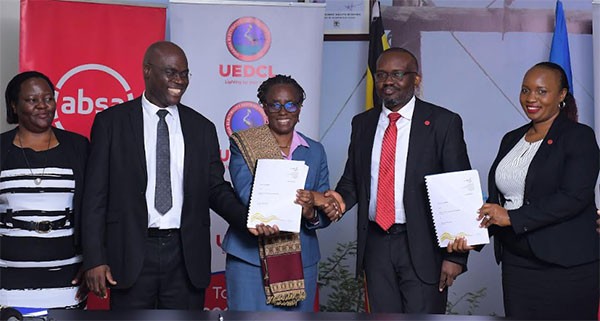
The agreement was signed in Kampala during a ceremony attended by senior executives from Absa Bank Uganda and UEDCL. The funding will enable UEDCL to accelerate investments aimed at improving electricity reliability, reducing system losses, and extending access to power across the country.
The financing comes at a critical moment as UEDCL continues to consolidate its role as the national electricity distributor, having officially taken over distribution operations on 1 April 2025. The transition signalled a new phase in Uganda’s energy sector, placing responsibility for electricity distribution fully under public stewardship.
Under the arrangement, the funds will be deployed to expand and reinforce existing power distribution lines, upgrade ageing infrastructure, and construct new substations to support growing demand. Additional investments will focus on the deployment of smart metering systems, digital technologies, and grid automation to improve operational efficiency and customer service.
Speaking at the signing ceremony, Absa Bank Uganda Managing Director, David Wandera, said the partnership reflects the bank’s commitment to financing projects that drive sustainable economic growth.
“Reliable electricity is a cornerstone of industrialisation, job creation and inclusive development,” Mr Wandera said. “By supporting UEDCL’s expansion programme, Absa Bank Uganda is contributing to the strengthening of national infrastructure that underpins productivity and competitiveness across all sectors of the economy.”
He added that the facility aligns with Uganda’s long-term development priorities, including increased industrial output, private sector growth, and improved service delivery to households and businesses.
On his part, UEDCL Managing Director, Paul Mwesigwa, described the financing as a significant step towards improving the reliability and reach of electricity supply nationwide. He noted that the investment will allow UEDCL to address long-standing challenges such as network congestion, technical losses, and limited access in fast-growing urban centres and underserved rural areas.
“This partnership with Absa Bank Uganda will enable UEDCL to fast-track priority projects that improve the quality and reliability of electricity supply,” Mr Mwesigwa said. “The result will be better service delivery for customers and stronger support for Uganda’s economic transformation.”
The funding is also expected to enhance UEDCL’s capacity to integrate renewable energy into the grid, supporting the country’s broader energy transition agenda. Improved distribution infrastructure will allow more efficient evacuation of power from generation plants, ensuring that increased generation capacity translates into reliable supply for end users.
Energy sector stakeholders have welcomed the financing, noting that a strong and financially supported national distributor is essential for achieving universal electricity access and sustaining economic growth. The improvements financed under the facility are expected to connect thousands of new customers, support small and medium-sized enterprises, and lower the cost of doing business through more reliable power supply.
As Uganda continues to invest in infrastructure development, partnerships between financial institutions and public utilities are expected to play a critical role in delivering long-term social and economic benefits. The Absa Bank Uganda–UEDCL financing arrangement represents a significant contribution towards building a resilient and modern electricity distribution system for the country.