

By Caroline.N
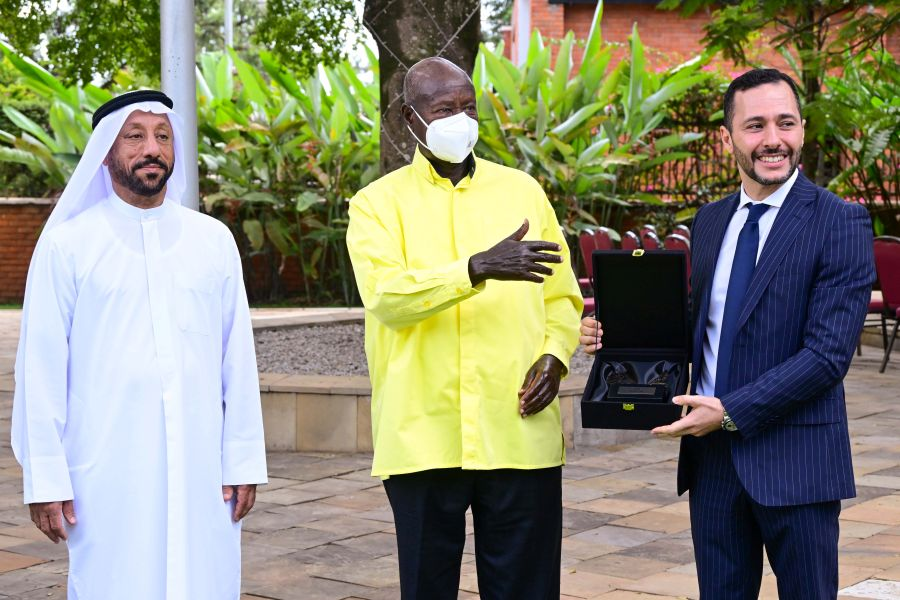
President Yoweri Kaguta Museveni has held high-level discussions with investors from the United Arab Emirates (UAE) on plans to construct an inland port in Uganda, a project expected to significantly enhance the country’s trade logistics, regional connectivity and industrial growth.
The proposed inland port is part of Uganda’s broader strategy to modernise transport and trade infrastructure, reduce the cost of doing business, and strengthen its position as a regional trade hub for East and Central Africa. The facility would serve as a critical logistics node, linking Uganda more efficiently to regional and international markets through road, rail and inland water transport networks.
During the meeting, President Museveni emphasised the importance of infrastructure development in supporting economic transformation and value addition. He noted that efficient logistics systems are essential for facilitating exports, boosting manufacturing, and improving access to global markets for Ugandan products.
“The development of an inland port will enhance efficiency in cargo handling, reduce delays, and lower transport costs for traders and investors,” the President said. He added that Uganda’s strategic location at the heart of East Africa makes it an ideal centre for regional trade and logistics operations.
The UAE investors expressed strong interest in partnering with the Government of Uganda to develop the facility, citing the country’s political stability, growing economy and commitment to infrastructure development. They highlighted the UAE’s extensive experience in port development, logistics management and free-zone operations, which they said could be leveraged to support Uganda’s ambitions.
According to officials present at the meeting, the inland port would be designed to handle cargo clearance, storage, consolidation and distribution, easing congestion at regional seaports and border points. It is also expected to support Uganda’s import and export activities by streamlining customs processes and improving supply chain efficiency.
The project is aligned with ongoing government efforts to expand Uganda’s transport infrastructure, including the revival of railway services, upgrades to key highways, and increased investment in industrial parks. Once operational, the inland port is expected to complement these initiatives by providing a centralised logistics platform for cargo destined for both domestic and regional markets.
Government officials noted that the inland port would also play a key role in supporting Uganda’s industrialisation agenda. By improving access to raw materials and export routes, the facility is expected to attract new investment into manufacturing, agro-processing and mineral development, creating jobs and boosting exports.
The discussions also touched on the potential integration of the inland port with regional transport corridors, including links to neighbouring countries. This would enhance cross-border trade and reinforce Uganda’s role as a transit route for goods moving within the East African region.
President Museveni welcomed the interest from UAE investors and reiterated the government’s readiness to provide a conducive investment environment. He assured the delegation of policy stability, investor protection and support in facilitating necessary approvals and partnerships.
The UAE has in recent years emerged as a key investment partner for Uganda, with growing cooperation in sectors such as energy, infrastructure, agriculture, real estate and logistics. The proposed inland port project is seen as a further deepening of economic ties between the two sides.
Technical teams from both Uganda and the UAE are expected to continue engagements to assess feasibility, location options and investment structures for the project. Once completed, the inland port is anticipated to play a transformative role in Uganda’s trade ecosystem, strengthening supply chains and supporting sustainable economic growth.